


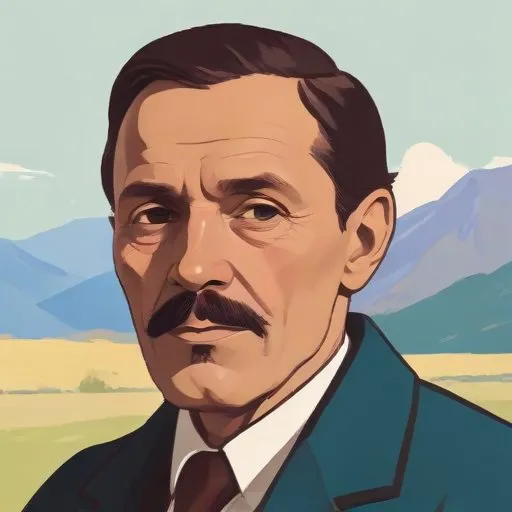
A pioneering artist and educator who merged photography and painting to create innovative, expressive works that emphasized composition and tone. Known for his influence on modern art education and the development of the "Dow System" of art instruction.
Arthur Wesley Dow, a renowned American painter, printmaker, photographer, and arts educator, is best known for his groundbreaking contributions to modern art education and his influence on some of America's most iconic artists. His innovative teaching methods and emphasis on individual creativity paved the way for generations of artists to come.
Arthur Wesley Dow was born on April 6, 1857, in Ipswich, Massachusetts. He received his first art training in 1880 from Anna K. Freeland of Worcester, Massachusetts. The following year, Dow continued his studies in Boston with James M. Stone, a former student of Frank Duveneck and Gustave Bouguereau.
In 1884, Dow traveled to Paris to further his art education, studying at the Académie Julian under the supervision of academic artists Gustave Boulanger and Jules Joseph Lefebvre. This period of his life had a profound impact on his artistic style and would later influence his teaching methods.
Dow's teaching career spanned several decades and institutions. He taught art at the Pratt Institute from 1896 to 1903, the New York Art Students League from 1898 to 1903, and founded the Ipswich Summer School of Art in 1900. He served as a professor of fine arts at Columbia University Teachers College from 1904 to 1922.
His teaching philosophy emphasized individual creativity, experimentation, and exploration. He encouraged his students to break away from traditional techniques and develop their own unique styles. This approach attracted some of the most talented and innovative artists of the time, including Georgia O'Keeffe, Charles Sheeler, and Charles Burchfield.
Dow's influence on modern art is undeniable. He introduced his students to the art of Japanese ukiyoe woodblock prints, which greatly influenced the development of American modernism. He also designed posters and commercial works, showcasing his versatility as an artist.
As an educator, Dow played a crucial role in shaping the art education system in the United States. He believed that art education should be accessible to everyone, regardless of social class or background. His pioneering work in this field continues to inspire art educators today.
In 1893, Dow married Eleanor Pearson, and together they had no children. He passed away on December 13, 1922, in his home in New York City, leaving behind a legacy of artistic innovation and educational excellence.
Today, Dow's work can be found in several prominent museums and private collections, including the Museum of Fine Arts, Boston, and the Metropolitan Museum of Art. His contributions to modern art education continue to inspire artists, educators, and enthusiasts alike.
Born in 1856
A renowned portrait painter, capturing the essence of high society with his stunning watercolors and oils, leaving an indelible mark on the art world.
Born in 1836
A renowned artist capturing American life and landscapes through his evocative paintings and illustrations, particularly focusing on the Civil War and coastal scenes.
Born in 1844
A pioneering American artist who explored the human form through realistic and psychologically complex works, capturing the spirit of his subjects with unflinching honesty.
Born in 1844
An American Impressionist painter and educator, she created intimate, tender portraits of women and children, capturing the quiet beauty of everyday life. Her artwork often explored the complexities of motherhood and femininity.
Born in 1835
A pioneering artist who explored new techniques in stained glass and painting, creating vibrant, dreamlike works that blended Eastern and Western styles.
Born in 1859
An American Impressionist painter and illustrator, known for capturing the essence of urban life and landscapes, particularly in his iconic flag-themed works.
Born in 1849
A prominent figure in American art, he was a master of Impressionism and a devoted teacher, shaping the development of American art through his work and students.
Born in 1865
A pioneering figure in American art, known for advocating for a more spontaneous and expressive approach to painting, and for teaching and mentoring many notable artists.
