


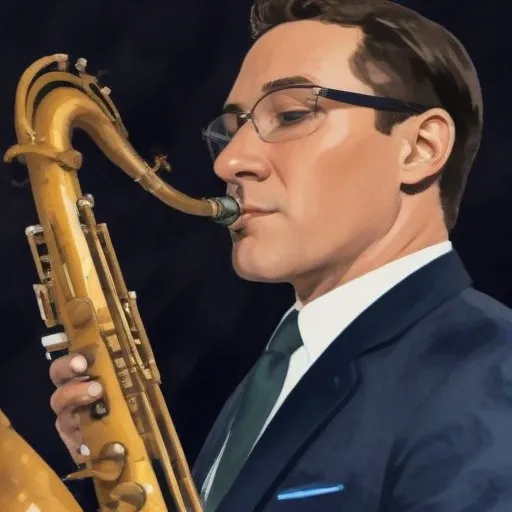
A jazz legend who led his own orchestra and composed iconic tunes, known for his smooth, melodic saxophone playing and contributions to the "Chicago Style" of jazz.
Bud Freeman, born Lawrence Freeman, was an American jazz musician, bandleader, and composer, renowned for his exquisite tenor saxophone playing, as well as his skill on the clarinet. With a career spanning over six decades, he left an indelible mark on the jazz scene, earning the nickname "The Eel" for his serpentine improvisations.
In 1922, Freeman, alongside his high school friends, formed the Austin High School Gang, which was heavily influenced by the New Orleans Rhythm Kings and Louis Armstrong. This early exposure to jazz legends shaped his unique style, which would later become a hallmark of his performances.
Moving to New York City in 1927, Freeman worked as a session musician and band member with notable jazz enthusiasts, including Red Nichols, Roger Wolfe Kahn, Ben Pollack, and Joe Venuti. His breakthrough performance came in 1933 with Eddie Condon's recording of "The Eel," which solidified his reputation as a master improviser.
Freeman's illustrious career saw him work with iconic musicians, including Tommy Dorsey's Orchestra (1936-1938), Benny Goodman's band (1938), and his own Summa Cum Laude Orchestra (1939-1940). During World War II, he led a U.S. Army band in the Aleutian Islands, and later, after the war, he continued to lead his own groups and collaborate with notable musicians like Buck Clayton, Ruby Braff, Vic Dickenson, and Jo Jones.
In the 1960s, Freeman wrote the book and lyrics for the Broadway musical "Beg, Borrow or Steal," which featured the popular ballad "Zen Is When." He later became a member of the Worlds Greatest Jazz Band (1969-1970) and continued to perform and record until his move to England in 1974. Freeman spent time on the Isle of Man, where he was a guest of local musician Jim Caine, before returning to Chicago in 1980.
Freeman penned two memoirs, "You Don't Look Like a Musician" (1974) and "If You Know of a Better Life, Please Tell Me," providing an intimate glimpse into his remarkable life and career. His contributions to jazz continue to inspire generations of musicians, cementing his status as one of the most revered figures in jazz history.
Bud Freeman's extensive contributions to jazz have left an indelible mark on modern music. His innovative approach to improvisation and his ability to blend clarinet and tenor saxophone playing have inspired countless musicians, ensuring his legacy as a true jazz legend.
Bud Freeman's remarkable life and career serve as a testament to his dedication to jazz and his unwavering passion for music. As we reflect on his incredible journey, we are reminded of the power of creativity and the importance of preserving the rich heritage of jazz.
Born in 1909
A pioneering jazz musician who introduced a smoother, more relaxed style of saxophone playing, influencing generations of musicians to come.
Born in 1904
A pioneering jazz musician who revolutionized the saxophone's role in jazz, creating a rich, full-bodied sound that influenced generations of musicians.
Born in 1909
A renowned tenor saxophonist, known for his smooth, full-bodied tone and influential improvisational style that blended swing and bebop. He's a jazz legend, playing with icons like Duke Ellington and Coleman Hawkins.
99 Years Old
A legendary jazz saxophonist who brought Brazilian bossa nova to the global stage, winning multiple Grammys and selling millions of records.
Born in 1925
A virtuosic saxophonist and composer, known for his smooth, lyrical tone and improvisational mastery, blending swing, bebop, and cool jazz styles.
Born in 1918
A renowned jazz pianist, composer, and bandleader, known for his elegant and versatile style, which spanned multiple genres and collaborations with legendary musicians.
Born in 1920
A pioneering jazz saxophonist and composer, known for his lightning-fast solos and innovative bebop style that revolutionized jazz music. 82
