


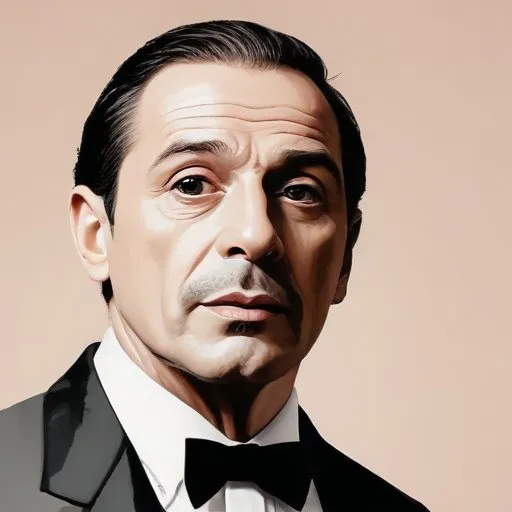
A renowned Italian actor and singer, celebrated for his powerful voice and iconic performances in opera and film, leaving a lasting legacy in the world of classical music.
Caffarelli, born Gaetano Majorano, was a renowned Italian castrato and opera singer who dominated the European opera scene in the 18th century. Known for his sublime vocal prowess and captivating stage presence, Caffarelli was hailed as one of the greatest singers of his time, earning the admiration of royalty and commoners alike.
Caffarelli was born on April 12, 1710, in Bitonto, Italy, to Vito Majorano and Anna Fornella. His early life is shrouded in uncertainty, but it is believed that he was drawn to music from a young age. According to legend, Caffarelli's stage name was taken from an early teacher, Caffaro, who taught him music in childhood. Others claim that it was derived from a patron, Domenico Caffaro.
What is certain, however, is that Caffarelli was deeply passionate about music and desired to become a eunuch, undergoing castration to preserve his soprano voice. At the tender age of 10, he was given the income from two vineyards owned by his grandmother to study grammar and music, paving the way for his future success.
Caffarelli's talent and dedication eventually led him to become the pupil of Nicola Porpora, a renowned Italian composer and singing teacher. Under Porpora's guidance, Caffarelli honed his craft, perfecting his technique and developing his unique vocal style.
Caffarelli's professional debut came in 1726 at the age of 15, when he performed in Domenico Sarro's Valdemaro at Rome's Teatro Capranica. He quickly gained recognition throughout Italy, performing in leading roles in Venice, Turin, Milan, and Florence.
In 1733, Caffarelli made his London debut at the King's Theatre, creating roles in Giovanni Battista Pescetti's Arsace and George Frideric Handel's Faramondo and Serse. Although his time in London was not particularly successful, owing to the lingering popularity of Farinelli, Caffarelli's talent and reputation continued to grow.
Over the course of his illustrious career, Caffarelli worked in Madrid, Vienna, Versailles, and Lisbon, performing in numerous operas and concertos. His repertoire included works by prominent composers such as Johann Adolf Hasse, Niccolò Jommelli, and Christoph Willibald Gluck.
Caffarelli's legacy extends far beyond his impressive vocal range and technical prowess. He helped to popularize opera throughout Europe, bringing it to a wider audience and cementing its place in the world of classical music.
As one of the most celebrated castrati of his time, Caffarelli paved the way for future generations of opera singers. His impact on the development of opera as an art form is immeasurable, and his music continues to inspire and delight audiences to this day.
Caffarelli's life was marked by his intense passion for music and his dedication to his craft. Despite the challenges he faced as a castrato, he remained committed to his art, earning the respect and admiration of his contemporaries.
In his later years, Caffarelli continued to perform and teach, leaving behind a rich legacy that would inspire future generations of opera singers and music lovers alike.
Caffarelli passed away on January 31, 1783, leaving behind a body of work that continues to captivate and inspire audiences to this day.
Born in 1714
A prominent composer of the Neapolitan School, he wrote over 80 operas and was a key figure in the transition between the Baroque and Classical periods. His music was known for its dramatic intensity and expressive melodies.
Born in 1710
A Baroque composer, violinist, and organist who made significant contributions to the development of opera and sacred music, particularly with his famous "Stabat Mater" composition.
Born in 1797
A renowned Italian composer of the Romantic era, best known for his operas, particularly "L'elisir d'amore" and "Don Pasquale", which are still widely performed today.
Born in 1801
Operatic mastermind behind bel canto classics like "Norma" and "La Sonnambula", renowned for their beautiful, expressive melodies and dramatic flair.
Born in 1792
Operatic mastermind behind iconic comedies like "The Barber of Seville" and "William Tell," crafting catchy, witty, and playful music that still delights audiences today.
Born in 1749
An 18th-century Italian composer and educator, known for his operas and sacred music, particularly his comic operas that showcased his mastery of melody and harmony.
Born in 1728
An 18th-century Italian composer and educator, known for his operas and influence on the development of classical music. He was a prominent figure in the Neapolitan school of opera composition.
