


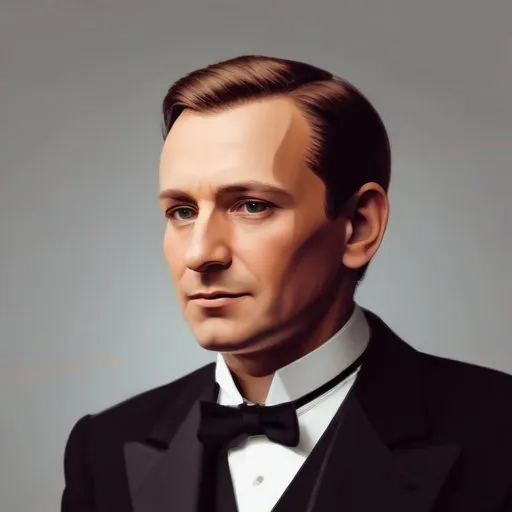
A renowned Polish-German conductor, known for his interpretations of classical music, particularly the works of Richard Wagner and Anton Bruckner. He was a prominent figure in European classical music scenes during the mid-20th century.
Renowned for his interpretations of classical masterpieces, Carl Schuricht was a German conductor who left an indelible mark on the world of music. With a career spanning over six decades, he was known for his exceptional skill in bringing complex symphonies to life, earning him the respect of contemporaries and audiences alike.
Born on July 3, 1880, in Danzig, German Empire (now Gdańsk, Poland), Schuricht's life was surrounded by music from an early age. His mother, Amanda Wusinowska, a widow, raised him alone after his father's tragic death in the Baltic Sea. Sundays were spent singing choral works by Bach, Handel, and Mendelssohn with family and friends, fostering his love for music.
Schuricht began studying piano and violin at the age of six and was composing by eleven. He pursued his academic and musical studies in Berlin and Wiesbaden, eventually becoming a Korrepetitor at the Stadttheater in Mainz at twenty. His talent earned him the Kuczynski Foundation prize for composition and a Felix Mendelssohn scholarship, allowing him to study piano under Ernst Rudorff and composition with Engelbert Humperdinck.
Schuricht's fascination with conducting led him to undertake tours in Germany, conducting operettas, operas, choral societies, and symphony concerts. During this period, he had the opportunity to observe legendary conductors like Arthur Nikisch, Felix Weingartner, and Gustav Mahler at rehearsals and concerts.
In 1906, he attended the premiere of Mahler's Sixth Symphony, conducted by the composer himself. This experience had a profound impact on Schuricht, solidifying his commitment to conducting.
Schuricht's conducting career was marked by notable collaborations with prominent composers. In 1906, he met Frederick Delius, promising to conduct his Sea Drift when he had his own orchestra. He fulfilled this promise in Frankfurt, with Delius in attendance.
His extensive repertoire included works by Bruckner, Brahms, and Strauss, earning him acclaim for his interpretations of classical masterpieces. Schuricht's performances were characterized by a deep understanding of the composer's intent, combined with a palpable sense of energy and passion.
Schuricht's contributions to classical music are undeniable. He played a crucial role in popularizing the works of prominent composers, making them accessible to a broader audience. His dedication to his craft inspired future generations of conductors and musicians.
Throughout his career, Schuricht received numerous awards and honors, including the Golden Badge of Honor from the City of Vienna and the Grand Cross of the Order of Merit of the Federal Republic of Germany.
Carl Schuricht's legacy continues to influence the world of classical music, his passion and dedication serving as a testament to the power of music to bring people together.
Schuricht's love for music was evident in every aspect of his life and career. His remarkable journey, marked by perseverance and dedication, serves as an inspiration to aspiring musicians and conductors today.
Born in 1886
A renowned German conductor and composer, he was a dominant figure in the Berlin Philharmonic, known for his intense and expressive performances of Beethoven, Brahms, and Bruckner. He was also a composer of symphonies and other works.
Born in 1908
A renowned maestro who led the Berlin Philharmonic for over three decades, elevating its reputation through precise and dramatic performances. He's also famous for his numerous recordings and charismatic stage presence.
Born in 1912
A renowned maestro who led the Chicago Symphony Orchestra to international acclaim, known for his intense performances and numerous recordings of operas and symphonies.
Born in 1885
A renowned composer and conductor, known for his interpretations of Beethoven and Bruckner, and his leadership of the Berlin State Opera and Los Angeles Philharmonic.
Born in 1902
A renowned German conductor, he led prestigious orchestras, including the Berlin Philharmonic, and was particularly acclaimed for his interpretations of Bruckner, Wagner, and Strauss.
Born in 1888
A renowned German conductor, celebrated for his interpretations of Richard Wagner's operas, particularly his iconic performances of "Der Ring des Nibelungen" at the Bayreuth Festival.
Born in 1894
A renowned opera conductor and director, celebrated for his interpretations of Mozart, Wagner, and Strauss, leading top orchestras and opera houses worldwide.
