


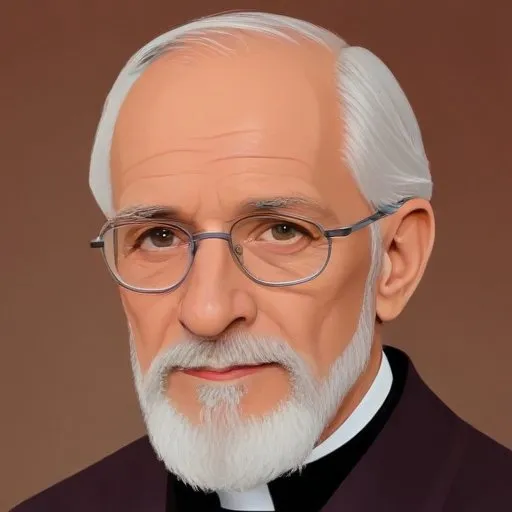
A 19th-century theologian and author who challenged traditional Christian views with his historical-critical approach, sparking controversy and influencing later theologians.
David Friedrich Strauss, a liberal Protestant theologian, is renowned for his provocative portrayal of the historical Jesus, challenging the traditional understanding of Christianity. His groundbreaking work, which spans over four decades, has reshaped the landscape of biblical scholarship, sparking heated debates and redefining the boundaries of faith and reason.
Born on January 27, 1808, in Ludwigsburg, near Stuttgart, Germany, Strauss was sent to the evangelical seminary at Blaubeuren at the age of 12 to prepare for theological studies. Under the guidance of Professors Friedrich Heinrich Kern and Ferdinand Christian Baur, he developed a profound appreciation for classical literature and textual criticism, laying the foundation for his future pursuits.
In 1825, Strauss entered the University of Tübingen, where he was exposed to the philosophical teachings of Friedrich Wilhelm Joseph Schelling, Jakob Böhme, Friedrich Schleiermacher, and Georg Wilhelm Friedrich Hegel. Although he was initially drawn to Hegel's ideas, it was the lectures of Schleiermacher that sparked his interest in the life of Jesus, setting the course for his future research.
Strauss's magnum opus, Das Leben Jesu (The Life of Jesus), published in 1835, sent shockwaves throughout the theological community. By applying rigorous historical and literary analysis to the New Testament, Strauss aimed to separate fact from myth, reevaluating the nature of Jesus' divinity. His conclusion – that Jesus was a historical figure whose divine nature was expressed through myth – sparked controversy and debate, cementing his reputation as a radical theologian.
Strauss's work was deeply influenced by the philosophies of Hegel and Schleiermacher, which emphasized the importance of understanding the historical context of religious texts. He believed that myths, far from being false, were expressions of profound truths, revealing the human experience and the essence of Christianity.
In 1847, Strauss resigned from his professorship at the University of Zürich, citing health reasons. He spent the remainder of his life devoted to writing, producing several influential works, including Der Christus des Glaubens und der Jesus der Geschichte (The Christ of Faith and the Jesus of History). Strauss passed away on February 8, 1874, leaving behind a legacy that continues to shape modern biblical scholarship.
Strauss's work has had a profound impact on modern theology, encouraging a more critical and nuanced approach to scriptural interpretation. His ideas have influenced generations of scholars, theologians, and philosophers, including Friedrich Nietzsche, who greatly admired Strauss's intellectual courage.
Strauss's radical views on Jesus' divinity sparked intense controversy, earning him both praise and criticism from his contemporaries. While some hailed him as a visionary, others denounced him as a heretic, exemplifying the complex and often contentious nature of theological inquiry.
"The question of the historicity of Jesus is one of the most important and most difficult of all the questions connected with the history of Christianity."
"Myth is not a fiction, but a presentation of the truth in a form adapted to the apprehension of the popular mind."
Strauss's work must be understood within the context of 19th-century Germany, a time of great intellectual and theological ferment. His ideas, though provocative, were part of a broader movement towards critical biblical scholarship, shaping the course of modern theology and beyond.
Born in 1768
A pioneering theologian and philosopher who shaped modern Christian thought and hermeneutics, known for his emphasis on individual experience and understanding of religious texts.
Born in 1770
A German philosopher and academic who developed a comprehensive and systematic philosophy that emphasized the unity of all things and the dialectical process of thesis, antithesis, and synthesis. His ideas have had a profound impact on modern thought, influencing fields such as philosophy, politics, and art.
Born in 1792
A 19th-century German theologian and scholar who pioneered the historical-critical method of biblical analysis, revolutionizing the field of New Testament studies.
Born in 1804
A 19th-century philosopher who critiqued religion and idealism, arguing that God is a human creation and that people should focus on this life rather than the afterlife. His ideas influenced many prominent thinkers, including Karl Marx and Friedrich Nietzsche.
Born in 1884
A German Lutheran theologian and professor who demythologized the New Testament, seeking its deeper meaning beyond supernatural elements, and developed the concept of "existentialist theology".
Born in 1886
A 20th-century theologian who redefined Christian doctrine with his emphasis on God's revelation and humanity's sinful nature, influencing modern Christian thought.
