


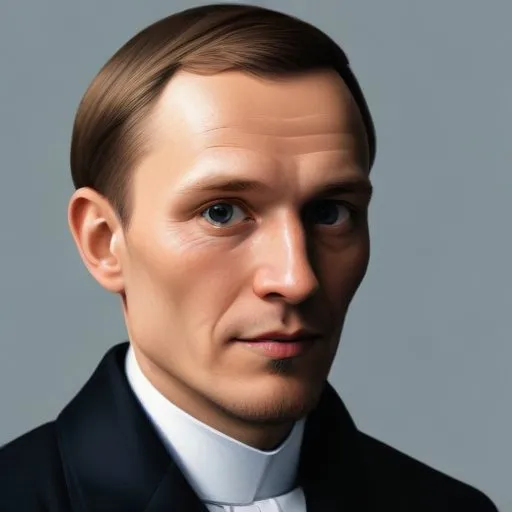
A 19th-century Estonian missionary and engraver, known for his contributions to the development of Estonian language and culture, as well as his artistic talents.
Eduard Magnus Jakobson was a renowned Estonian wood engraver and Baptist missionary, best known for his exquisite illustrations in various books and his iconic design of the masthead logo for Sakala, a prominent newspaper founded by his brother, Carl Robert Jakobson. His artistic talents and deep-rooted faith had a profound impact on the cultural and religious landscape of Estonia during the late 19th and early 20th centuries.
Born on February 5, 1847, in Torma, Estonia, Eduard Magnus Jakobson was raised in a family that valued education and the arts. His older brother, Carl Robert Jakobson, was a prominent figure in Estonian literature and journalism, and their family's love for learning and creativity laid the foundation for Eduard's future success.
As a wood engraver, Jakobson's work was characterized by its intricate details and ability to convey powerful emotions through his designs. He illustrated numerous books, including works by Estonian authors and poets, helping to promote the country's rich literary heritage.
In 1869, Jakobson converted to the Baptist faith, a decision that significantly impacted his life and career. His newfound faith led him to become a Baptist missionary, dedicating his life to spreading the word of God and promoting spiritual growth in Estonia.
Jakobson's design of the masthead logo for Sakala, a newspaper founded by his brother, remains an iconic symbol of Estonian journalism and culture. His wood engravings continue to inspire artists and designers to this day, serving as a testament to his enduring legacy in the world of art and faith.
Limited information is available on Jakobson's personal life, but it is known that he remained devoted to his faith and artistic pursuits throughout his life. He passed away on August 2, 1903, in Tallinn, Estonia, leaving behind a rich cultural heritage that continues to inspire generations.
Although Jakobson's original engravings are rare and highly valuable, his work has been preserved and digitized for modern audiences to appreciate. A selection of his engravings can be found in various online archives and cultural institutions, showcasing his mastery of wood engraving and design.
Eduard Magnus Jakobson's contributions to Estonian art, literature, and faith have left an indelible mark on the country's cultural landscape. His work continues to inspire artists, designers, and missionaries, ensuring his legacy endures for generations to come.
Today, Jakobson is remembered as a pioneering figure in Estonian art and faith, a true champion of cultural and spiritual growth in his homeland.
Born in 1874
Estonia's first president, a key figure in the country's struggle for independence from Russia, served as a unifying force during tumultuous times. He's remembered for his role in shaping Estonia's early years and its path to sovereignty.
Born in 1868
Estonia's 2nd Prime Minister, a pioneering journalist, lawyer, and politician who played a crucial role in the country's struggle for independence and development. He's most known for his efforts to establish a democratic government and promote national unity.
Born in 1884
Estonia's 7th Prime Minister, a lawyer and politician who played a crucial role in shaping the country's early years of independence, known for his diplomatic efforts and national unification.
Born in 1888
Estonian journalist and politician who served as the 6th Prime Minister of Estonia, known for his leadership during the country's interwar period and his role in shaping the nation's early years of independence.
Born in 1890
A prominent Estonian leader who served as the country's Prime Minister during a tumultuous period, guiding Estonia through World War II and the Soviet occupation. He's revered for his bravery and statesmanship during Estonia's struggle for independence.
Born in 1886
Estonia's Head of State during World War II, leading the country's government-in-exile and advocating for independence from Soviet occupation. He played a crucial role in preserving Estonia's sovereignty and identity.
Born in 1875
Estonia's second Prime Minister, a lawyer and politician, played a crucial role in shaping the country's early years, serving as a key figure in its struggle for independence. He's most known for his efforts in establishing Estonia's sovereignty and democratic government.
Born in 1873
Estonian surgeon and politician who served as the 19th Minister of Education, playing a significant role in shaping the country's education system. He was a pioneer in medical education and healthcare reform.
