


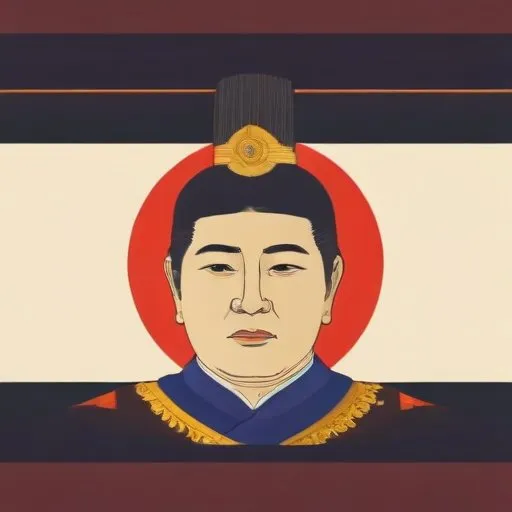
A short-lived emperor who reigned for only a year, known for his brief and tumultuous reign during a period of Japanese imperial succession crisis.
Emperor Chky, the 85th emperor of Japan, is known for his remarkably short-lived reign, spanning only two months in 1221. He is often referred to as the "Half-Emperor" or the "Later Dethroned Emperor GoHaitei," a nod to his controversial ascension to the throne.
Before ascending to the Chrysanthemum Throne, Emperor Chky was known as Kanenarishinnō. He was the first son of Emperor Juntoku and Ritsushi, daughter of Kujō Yoshitsune.
Emperor Chky was enthroned at the tender age of two, following the deposition of his father, Emperor Juntoku, in preparation for the Jōkyū Incident. However, his reign was short-lived, as he was dethroned and replaced by his first cousin once removed, Emperor Go-Horikawa, just two months later.
The Jōkyū Incident was an unsuccessful attempt by Retired Emperor Go-Toba to overthrow the Kamakura Bakufu. Although Emperor Chky's enthronement was not recognized due to his brief reign, he was later recognized as an emperor in 1870.
The Imperial Household Agency recognizes Kujō no misasagi, located near Tōfuku-ji in Fushimi-ku, Kyoto, as Emperor Chky's tomb.
Emperor Chky had a consort, Ukyō Nodaibu no Tsubone, and a daughter, Imperial Princess Yoshiko, who later became Wademon-in.
Emperor Chky's reign, although brief, marked a tumultuous period in Japanese history, highlighting the struggles for power between the imperial court and the Kamakura Bakufu. His story serves as a fascinating footnote in the annals of Japanese history, offering a glimpse into the complexities of medieval Japanese politics.
Despite his brief reign, Emperor Chky's story continues to captivate historians and enthusiasts alike, offering a unique glimpse into the intricacies of medieval Japanese politics and the imperial court.
Born in 1464
The 116th emperor of Japan, ruling from 1500 to 1526, known for his attempts to restore imperial power and authority during the Sengoku period. He's also famous for his cultural achievements, particularly in poetry and art.
Born in 1517
The 15th-century Japanese monarch who reigned during a period of civil war and is remembered for his attempts to restore imperial authority and promote cultural revival. He's also known for his patronage of the arts, particularly Noh theater.
Born in 1572
The 107th emperor of Japan, ruling from 1586 to 1603, known for his role in the transition from the Sengoku period to the Edo period, and for being the last emperor to hold significant power. He played a key role in the unification of Japan under the Tokugawa shogunate.
Born in 1596
The 108th emperor of Japan, ruling from 1611 to 1623, known for his cultural achievements, particularly in poetry and art, and for establishing the imperial court's independence from the shogunate.
Born in 1543
Unified Japan's warring states, establishing a dynasty that ruled for over 250 years, and is revered as a brilliant military strategist and statesman.
Born in 1537
A powerful Japanese warlord who unified Japan's warring states and led two invasions of Korea, leaving a lasting legacy in Japanese history. He's also known for his iconic Osaka Castle.
Born in 1530
A powerful feudal lord who unified Japan's Echigo Province and fought several battles, earning a legendary reputation for bravery and martial prowess.
