


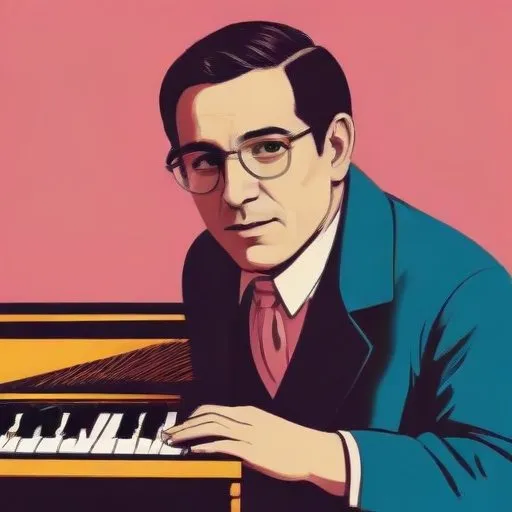
An 18th-century Italian organist and composer, known for his innovative and influential compositions that blended Baroque and Classical styles, leaving a lasting impact on the development of Western classical music.
Francesco Antonio Vallotti was an Italian composer, music theorist, and organist, renowned for his groundbreaking contributions to the understanding of harmony and counterpoint. His magnum opus, "Della scienza teorica e pratica della moderna musica" (On the Scientific Theory and Practice of Modern Music), cemented his legacy as a pioneer in the field of music theory.
Born on June 11, 1697, in Vercelli, Italy, Vallotti was blessed with an innate talent for music. He studied with G. A. Bissone at the Church of St. Eusebius, where his exceptional skills were noticed by Padre Beccaria of Vercelli. This recognition led to his admission to the novitiate in Chambéry around 1715. Vallotti went on to join the Franciscan order in 1716, following which he pursued his studies in philosophy at Cuneo and theology at Padua.
Vallotti's dedication to music theory and practice propelled him to become an organist at the Basilica di Sant'Antonio in Padua in 1722. Over time, he rose through the ranks, assuming the position of maestro in 1730, succeeding maestro Calegari. During his 50-year tenure, Vallotti collaborated with fellow theorist and composer Giuseppe Tartini, fostering a rich environment for musical innovation.
Vallotti's work on harmony and counterpoint led to the development of his signature system, known as Vallotti Temperament. This innovative approach to instrumental tuning enabled compositions in every key, with the six diatonic fifths (F-C-G-D-A-E-B) tuned 16/16 of a comma flat, while the remaining six fifths (B-F-C-G-D-A-F) were tuned pure. This resulted in thirds remarkably close to pure in certain keys, such as F, C, and G major, and D, A, E, and B minor.
In 1779, just a year before his passing, Vallotti published his seminal work, "Della scienza teorica e pratica della moderna musica." This exhaustive four-volume treatise distilled his life's work, providing a comprehensive understanding of harmony, counterpoint, and music theory. Vallotti's legacy extends beyond his theoretical contributions, as his work continues to influence modern music composition and performance.
Vallotti's pioneering work has had a lasting impact on modern music composition and performance. His theories on harmony and counterpoint continue to inspire new generations of musicians, theorists, and composers. As a testament to his enduring legacy, Vallotti's work remains an essential reference point for music enthusiasts and scholars alike.
Born in 1678
A virtuosic violinist and prolific composer, he crafted over 400 concertos, including "The Four Seasons," which remains a beloved and iconic masterpiece of classical music.
Born in 1710
A Baroque composer, violinist, and organist who made significant contributions to the development of opera and sacred music, particularly with his famous "Stabat Mater" composition.
Born in 1714
A prominent composer of the Neapolitan School, he wrote over 80 operas and was a key figure in the transition between the Baroque and Classical periods. His music was known for its dramatic intensity and expressive melodies.
Born in 1749
An 18th-century Italian composer and educator, known for his operas and sacred music, particularly his comic operas that showcased his mastery of melody and harmony.
Born in 1740
An 18th-century Italian composer and educator, known for his operas and contributions to the development of classical music. His works were widely performed and admired by European royalty and aristocracy.
Born in 1714
A pioneering opera composer who revolutionized the art form with his innovative and expressive works, blending music and drama in a way that captivated audiences.
Born in 1756
A child prodigy and master of classical music, he composed over 600 works, including symphonies, operas, and chamber music, that continue to inspire and influence musicians today.
Born in 1770
A musical genius who expanded the possibilities of classical music, creating iconic symphonies and piano sonatas that continue to inspire and influence generations of artists.
