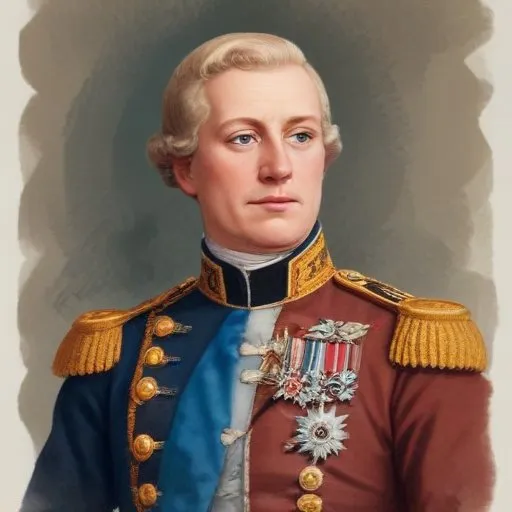
Frederick Augustus I of Saxony: The Unifier of Poland and Saxony
A Life Dedicated to Rehabilitation and Unity
Frederick Augustus I of Saxony, also known as Frederick Augustus III, is renowned for his valiant efforts to rehabilitate and recreate the Polish state, which had ceased to exist after the final partition of Poland in 1795. As the last Elector of Saxony from 1763 to 1806 and the first King of Saxony from 1806 to 1827, Frederick Augustus dedicated his life to unifying the fragmented territories and restoring the Polish throne.
Early Life and Family Background
Born on December 23, 1750, Frederick Augustus was the second but eldest surviving son of
Frederick Christian, Elector of Saxony, and Maria Antonia Walpurgis, Princess of Bavaria. Due to his young age, his mother served as Regent until 1768, with his uncle, Prince
Francis Xavier, functioning as his representative. Through his father's side, he was descended from two kings of Poland, and through his mother's side, Siemowit, the first confirmed duke of Poland.
The Quest for Polish Rehabilitation
Frederick Augustus's three predecessors as Elector of Saxony had been kings of Poland, but due to his young age, he was not considered eligible during the 1764 Polish-Lithuanian royal election. However, when a constitution was ratified by the Polish Sejm, Frederick Augustus was named successor to King Stanisław II August. Through Article VII of that very constitution, the head of the Saxon Royal House was established as heir to the Polish throne.
Declining the Throne and Pursuing Unity
Despite being named successor, Frederick Augustus declined to accept the crown upon Stanisław's death in 1798. Instead, he focused on reestablishing an independent Polish nation, a goal that would become the driving force behind his political career. Although he did not succeed in his lifetime, his efforts earned him the admiration and loyalty of the Polish people.
Rise to Power and Key Accomplishments
As the first King of Saxony, Frederick Augustus implemented various reforms, including the creation of a new constitution and the establishment of a more efficient administrative system. He also played a crucial role in the Napoleonic Wars, siding with Napoleon and becoming the Duke of Warsaw from 1807 to 1815.
Legacy and Cultural Impact
Frederick Augustus's legacy extends beyond his political achievements. The Augustusplatz in Leipzig is named after him, a testament to his enduring impact on the cultural landscape of Saxony. Moreover, his commitment to Polish rehabilitation has inspired generations of Polish patriots, earning him a revered place in Polish history.
Personal Milestones and Key Life Events
- December 23, 1750: Born in Dresden, Saxony
- 1763: Became the Elector of Saxony upon his father's death
- 1768: Mother's regency ended, and he began to rule in his own right
- 1806: Became the first King of Saxony
- 1807-1815: Served as the Duke of Warsaw
- May 5, 1827: Died in Dresden, Saxony
Historical Context and Comparative Analysis
Frederick Augustus's reign coincided with a tumultuous period in European history, marked by the rise and fall of empires and the reconfiguration of national borders. In contrast to his contemporaries, such as
Napoleon Bonaparte and
Frederick the Great, Frederick Augustus's dedication to Polish rehabilitation and unity sets him apart as a champion of national sovereignty and self-determination.
Trivia and Fun Facts
- Frederick Augustus was known for his linguistic skills, speaking fluent German, Polish, French, and Italian.
- He was a patron of the arts, supporting composers such as Carl Maria von Weber and Johann Gottlieb Naumann.
- The Augustusplatz in Leipzig features a majestic statue of Frederick Augustus, erected in 1836.
FAQ
What was Frederick Augustus Is role in Saxon history?
Frederick Augustus I was a significant figure in Saxon history who ruled as the Elector of Saxony and later as the King of Saxony. He played a key role in the Napoleonic Wars and was a prominent figure in European politics.
How did Frederick Augustus I contribute to the development of Saxony?
Frederick Augustus I contributed to the development of Saxony by promoting economic growth, reforming the government, and supporting the arts and education. He also expanded the Saxon army and established a strong military presence.
What was Frederick Augustus Is relationship with Napoleon Bonaparte?
Frederick Augustus I had a complex relationship with Napoleon Bonaparte. He initially allied with Napoleon but later turned against him, joining the coalition of European powers that eventually defeated the French emperor.
How did Frederick Augustus Is reign impact the German Confederation?
Frederick Augustus Is reign had a significant impact on the German Confederation, a loose association of German states. He played a key role in the Confederations formation and worked to promote cooperation and unity among the member states.
What is Frederick Augustus Is legacy in European history?
Frederick Augustus Is legacy in European history is that of a skilled politician and military leader who played a significant role in the Napoleonic Wars and the development of Saxony. He is remembered as a key figure in the history of Europe.