


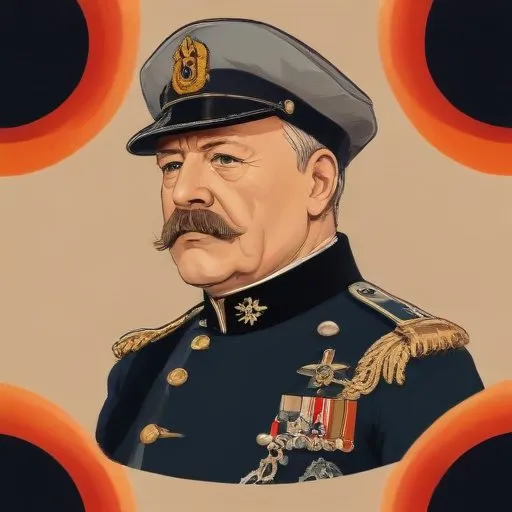
A German army officer and writer who served in the Franco-Prussian War and wrote about his experiences, offering valuable insights into 19th-century warfare. His military memoirs are still studied by historians today.
Friedrich Wilhelm von Bismarck, a German lieutenant general, diplomat, and military writer, is renowned for his significant contributions to the military-political sphere, particularly during the Napoleonic Wars. His extensive writings on military history and politics showcased his unwavering support for Napoleon, earning him recognition as a prominent military strategist of his time.
Born on July 28, 1783, in Windheim, Westphalia, von Bismarck hailed from the Rhineland branch of the Schnhausen line of the House of Bismarck. He embarked on his military journey in 1796 as a cornet in the Hanoverian Army, later joining the army of Nassau in 1803. His military prowess led him to the King's German Legion, where he fought in northern Germany in 1805.
In 1807, von Bismarck left the King's German Legion due to a duel, taking up a position as a cavalry captain in the Army of Württemberg. This new chapter in his military career coincided with his marriage to Augusta Amalia, a daughter of Frederick Augustus, Duke of Nassau, on September 7, 1807.
Von Bismarck's exceptional military skills propelled him to distinction during the Napoleonic Wars. Under the command of Marshal André Masséna, he excelled at the battle near Riedau on May 1, 1809. His bravery and strategic acumen earned him recognition, as he went on to participate in the battles of Bautzen, Seifersdorf, and Dennewitz.
After being captured at the Battle of Leipzig, von Bismarck's allegiances shifted as Württemberg changed sides to fight against Napoleon. He was appointed to the general staff and later made commander-in-chief of the Crown Provinces in 1815. His military prowess and diplomatic skills earned him the title of Graf (count) and the rank of oberst and flugeladjutant.
Following the reign of William I of Württemberg, von Bismarck was entrusted with reorganizing the army's cavalry, a task he accomplished with remarkable success. He became a major general in 1819 and a member of the Kammer der Standesherren in the Estates of Württemberg.
In 1820, von Bismarck was appointed as extraordinary envoy to the court at Karlsruhe, and five years later, he became ambassador to the Kingdom of Prussia, the Kingdom of Saxony, and the Kingdom of Hanover. His diplomatic career was marked by his astute negotiation skills and his ability to navigate complex political landscapes.
Friedrich Wilhelm von Bismarck's contributions to military history and politics continue to be celebrated. His extensive writings, including his military-political works and military histories, serve as a testament to his profound impact on the Napoleonic Wars. His diplomatic expertise and military acumen have left an indelible mark on the annals of history.
Von Bismarck's legacy extends beyond his military and diplomatic achievements. He remains an icon of a bygone era, a testament to the power of human ingenuity, and a beacon of inspiration for generations to come.
Born in 1815
Unified Germany's founder, a master strategist who forged a nation through diplomacy and war, leaving a lasting legacy in European politics.
Born in 1849
A German naval strategist who transformed the German Navy into a major world power, and is credited with building the German U-boat fleet that threatened Britain's naval supremacy during World War I.
Born in 1847
A German field marshal and politician who served as the 2nd President of Germany during the Weimar Republic, playing a crucial role in the rise of the Nazi Party. He's infamous for appointing Adolf Hitler as Chancellor of Germany in 1933.
Born in 1865
A German general and politician who played a crucial role in World War I, masterminding the 1918 Spring Offensive and later promoting Nazi ideology.
Born in 1879
A German nobleman who served as Chancellor of Germany in 1932, known for his role in appointing Adolf Hitler as Chancellor, paving the way for the Nazi regime.
Born in 1882
A German general and politician who briefly served as Chancellor of Germany in 1933, known for his failed attempts to stabilize the Weimar Republic and his role in Hitler's rise to power.
Born in 1885
Chancellor of Germany during the Weimar Republic, implemented austerity measures to address the Great Depression, but ultimately failed to prevent Hitler's rise to power.
Born in 1897
A mastermind of Nazi propaganda, he crafted a persuasive narrative that fueled the Third Reich's rise to power, leaving a lasting impact on the world.
