


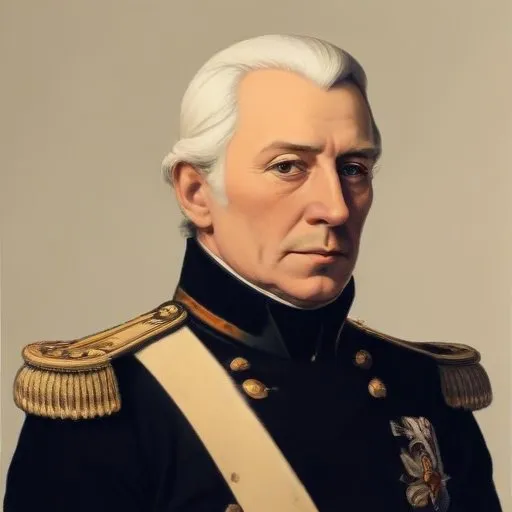
A skilled Prussian cavalry general who played a crucial role in the Seven Years' War, earning him recognition as one of the greatest cavalry commanders in history. He's revered for his bravery, tactical genius, and unwavering loyalty to Frederick the Great.
Friedrich Wilhelm von Seydlitz, a name synonymous with bravery, tactical brilliance, and unwavering dedication to the Prussian Army. He is renowned as one of the greatest cavalry generals in Prussian history, responsible for catapulting the Prussian cavalry to unprecedented heights during the Seven Years War.
Born on February 3, 1721, Seydlitz's life was marked by tragedy and mentorship. His cavalryman father retired and passed away when Seydlitz was still young, leaving him in the care of Margrave Frederick William of Brandenburg-Schwedt. Under the Margrave's guidance, Seydlitz's exceptional horsemanship and fearlessness earned him recognition as a standout subaltern.
Seydlitz's career in the War of Austrian Succession (1740-1748) saw him emerge as a formidable Rittmeister (cavalry captain) during the First and Second Silesian wars. His reputation as a courageous and skilled leader spread throughout the Prussian Army, solidifying his position as a trusted officer.
The Seven Years War proved to be Seydlitz's crowning glory. He masterminded the Prussian cavalry's triumphs, revolutionizing its tactics and capabilities. His coup d'œil (ability to assess the battlefield situation at a glance) allowed him to expertly interpret the King's directives and adapt them into flexible tactics. At the Battle of Rossbach, Seydlitz's cavalry played a pivotal role in routing the French and Imperial armies, earning him the Order of the Black Eagle on the battlefield. This distinction was preceded by the Pour le Mérite for his bravery at the Battle of Kolin.
Seydlitz's cavalry also played a crucial role in crushing the Habsburg and Imperial left flank at the Battle of Leuthen. He suffered multiple wounds in battle, including a severe injury at the Battle of Kunersdorf in August 1759, which led to his semi-retirement and appointment as the protector of the city of Berlin. Seydlitz's health issues forced him to sit out the remainder of the war, resuming his military duties in 1761.
Seydlitz's relationship with Frederick the Great was marked by periods of estrangement, but the two eventually reconciled during Seydlitz's final illness. This reconciliation was a testament to the enduring respect and admiration between the two men.
Friedrich Wilhelm von Seydlitz's remarkable military career left an indelible mark on the Prussian Army. He is remembered as one of the greatest cavalry generals in Prussian history, celebrated for his unwavering courage, tactical genius, and dedication to his country. Seydlitz passed away on November 8, 1773, leaving behind a legacy that continues to inspire military leaders to this day.
Born in 1712
Prussian king who ruled with Enlightenment values, promoting arts, education, and religious tolerance, while also being a skilled military strategist and expanding his kingdom through wars.
Born in 1755
A pioneering military reformer who modernized the Prussian army and played a key role in the Napoleonic Wars, known for his innovative tactics and strategic thinking.
Born in 1847
A German field marshal and politician who served as the 2nd President of Germany during the Weimar Republic, playing a crucial role in the rise of the Nazi Party. He's infamous for appointing Adolf Hitler as Chancellor of Germany in 1933.
Born in 1865
A German general and politician who played a crucial role in World War I, masterminding the 1918 Spring Offensive and later promoting Nazi ideology.
Born in 1876
A German naval leader who played a key role in the Kriegsmarine during World War II, overseeing the German U-boat fleet and naval operations. He was a close advisor to Adolf Hitler and implemented the German naval strategy during the war.
Born in 1888
A pioneering tank commander who revolutionized modern warfare with his innovative blitzkrieg tactics, earning him the nickname "Father of the Panzerwaffe".
