


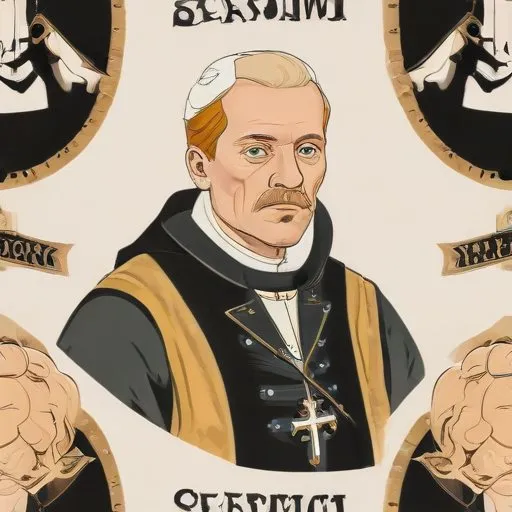
The Grand Master of the Teutonic Knights was the leader of a powerful medieval military order that played a significant role in the Baltic Crusades, known for their military prowess and territorial expansion.
Friedrich of Saxony, also known as Friedrich von Sachsen or Friedrich von Wettin, is predominantly recognized as the 36th Grand Master of the Teutonic Order, serving from 1498 to 1510. During his 12-year reign, he played a crucial role in navigating the power struggle between the Teutonic Order and Poland over Prussia.
Born prematurely on October 26, 1473, in Torgau, Friedrich was the third and youngest surviving son of Albert III, Duke of Saxony, and Sidonie of Podbrady, daughter of George of Podebrady. As a member of the Albertine line, the junior branch of the prestigious House of Wettin, Friedrich was destined for greatness.
In 1498, Friedrich was elected Grand Master of the Teutonic Order, an esteemed position that gave him authority over the Order's holdings in Prussia. The Teutonic Order, hoping to strengthen their position, chose Friedrich due to his connections to the ruling Jagiellon dynasty of Poland through his brother George's marriage to Barbara, sister of King John I Albert of Poland.
As Grand Master, Friedrich faced intense pressure from Poland, which sought to exert control over the Teutonic Order's holdings in Prussia. King John I Albert of Poland demanded that Friedrich do homage for the Order's holdings, but Friedrich cleverly referred the matter to the Imperial Reichstag. The Reichstag ruled in Friedrich's favor, informing John I Albert that he could not interfere in the Grand Master's free exercise of power in Prussia.
Friedrich's strategic delaying tactics, coupled with the quick succession of three Polish kings during his reign, allowed him to maintain the Teutonic Order's autonomy and power in Prussia. Throughout his 12-year reign, Friedrich demonstrated unwavering dedication to the Order and its interests, earning him a place in history as one of the most notable Grand Masters of the Teutonic Order.
Friedrich died on December 14, 1510, in Rochlitz, leaving behind a legacy as a wise and cunning leader. In accordance with the customs of the Teutonic Order, Friedrich remained unmarried and without descendants, dedicating his life to the service of the Order.
In conclusion, Friedrich of Saxony, a shrewd and determined leader, left an indelible mark on the history of the Teutonic Order and the struggle for power in Prussia. His unwavering commitment to the Order and its interests has earned him a revered place in the annals of history.
Born in 1831
The last German Emperor and King of Prussia, ruling for just 99 days, he's known for his liberal reforms and being the father of Wilhelm II, who led Germany into World War I.
Born in 1797
Unified Germany's first emperor, ruling from 1871 to 1888, and instrumental in creating the German Empire. He's known for his military prowess and statesmanship.
Born in 1415
The last of the Habsburg emperors, he ruled the Holy Roman Empire from 1452 to 1493, known for his efforts to reform the empire and strengthen its central authority.
Born in 1815
Unified Germany's founder, a master strategist who forged a nation through diplomacy and war, leaving a lasting legacy in European politics.
Born in 1477
A 16th-century German archbishop who attempted to reform the Catholic Church and was a key figure in the Protestant Reformation. He's known for his efforts to reconcile Catholicism and Lutheranism.
Born in 1893
A high-ranking Nazi official, he was a decorated World War I fighter pilot and later became a prominent politician, serving as Minister President of Prussia. He's infamous for his role in the Nazi regime and war crimes trials.
