


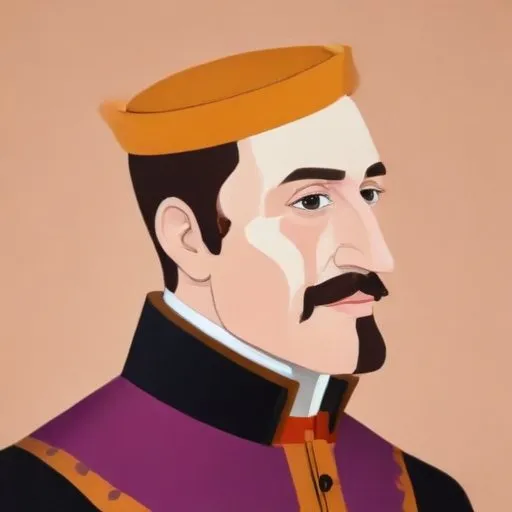
A French nobleman and military leader who played a key role in the Italian Wars, ultimately meeting his demise at the Battle of Ravenna in 1512. He's remembered for his bravery and tactical prowess.
Gaston of Foix, Duke of Nemours, was a renowned French military commander of the Renaissance, celebrated for his lightning-fast conquests and bold offensives that left a lasting impact on the battlefields of Italy. Nicknamed "The Thunderbolt of Italy," Gaston's meteoric rise to fame was cut short by his untimely death at the age of 22, but his legacy as a stellar commander has endured for centuries.
Born on December 10, 1489, in Mazères, County of Foix, Gaston was the second child and only son of John of Foix, Viscount of Narbonne, and Marie d'Orléans. His family ties were impressive, with his paternal grandparents being Gaston IV of Foix-Grailly and Queen Regnant Eleanor of Navarre, and his maternal grandparents being Charles, Duke of Orléans, and Marie of Cleves.
In 1511, at the age of 21, Gaston arrived in Italy as a new commander, bringing with him a fresh energy that shifted the conflict into higher gear. French forces had captured Bologna on May 13, 1511, and were under siege from a combined Papal-Spanish army commanded by Ramón de Cardona, the Viceroy of Naples. Gaston's bold decision to march his army to Bologna scattered the armies of the Holy League, forcing them to retreat to Ravenna.
In October 1511, Pope Julius II formed the Holy League with Ferdinand of Aragon and the Republic of Venice, with the aim of recovering lands taken from the Papacy and driving the French out of Italy. Gaston faced an invasion from the Swiss from the north, the Papal-Aragonese from the south, and Venice from the east. Undaunted, he unleashed a series of lightning-fast forced marches and sudden offensives that destabilized his enemies and earned him his nickname "The Thunderbolt of Italy."
Gaston's six-month campaign against the Holy League culminated in the Battle of Ravenna on April 11, 1512, where he met his untimely death at the age of 22. Despite his short-lived career, Gaston's military feats have been remembered for centuries, and he is regarded as a stellar commander well ahead of his time.
Gaston's military approach was characterized by speed, adaptability, and boldness, reflecting his conviction that a commander must be prepared to take calculated risks to achieve victory. His unorthodox tactics often caught his enemies off guard, demonstrating his ability to think on his feet and adjust to changing circumstances.
Though his life was cut short, Gaston of Foix, Duke of Nemours, left an indelible mark on the annals of military history, earning him a place among the greatest commanders of all time.
Born in 1519
King of France from 1547 to 1559, known for his cultural and artistic patronage, and his role in the Italian Wars.
Born in 1785
The last king of the French monarchy before the French Revolution, known for his tragic and mysterious life, including his imprisonment and disputed death.
Born in 1585
A powerful and cunning statesman who dominated French politics during the 17th century, known for his ruthless suppression of dissent and centralization of power. He was a master strategist and diplomat who shaped the course of European history.
Born in 1601
The queen who ruled France alongside her son Louis XIV, known as the Sun King, and played a significant role in shaping the country's politics and culture during the 17th century. She was a skilled diplomat and strategist who helped to establish France as a dominant European power.
Born in 1674
The Regent of France from 1715 to 1723, known for his cultural and artistic patronage, and his role in shaping the country's politics during a period of significant change.
Born in 1608
Third son of King Henry IV of France, a rebellious prince who plotted against his brother King Louis XIII and was known for his military prowess and romantic escapades.
Born in 1528
The Queen of Navarre was a powerful leader who ruled with a strong sense of justice and promoted the Protestant Reformation in France, playing a key role in the country's religious wars. She was a patron of the arts and a strong advocate for women's rights.
