


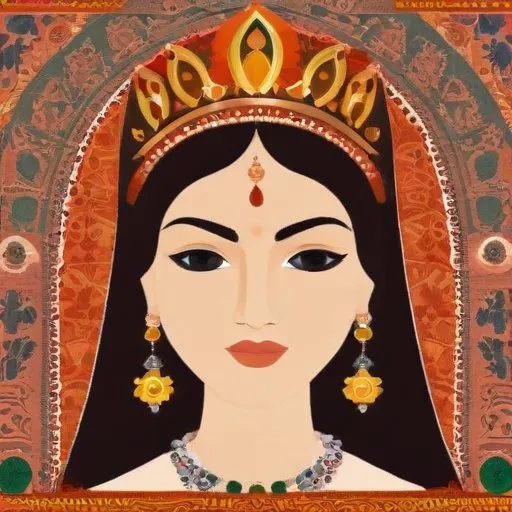
Mughal Empire's first and only female ruler, known for her diplomatic and military prowess, playing a crucial role in maintaining the empire's stability during her brother's reign.
Gauharara Begum, the daughter of the mighty Mughal Emperor Shah Jahan, is known for her bravery, intelligence, and strategic thinking that helped her brother Aurangzeb ascend to the throne. She played a pivotal role in the Mughal Empire during the 17th century, leaving an indelible mark on Indian history.
Born in 1631, Gauharara was the youngest child of Shah Jahan and his beloved wife Mumtaz Mahal. She grew up in a opulent environment, surrounded by the finest education and luxuries of the Mughal court. Despite being a woman in a patriarchal society, Gauharara was encouraged to develop her intellectual and martial skills, which would later serve her well in her quest for power.
After the death of her mother, Gauharara's father was imprisoned by his son Aurangzeb, who usurped the throne. Sensing an opportunity, Gauharara emerged as a shrewd strategist, using her wit and charm to convince her brothers to side with Aurangzeb. Her efforts paid off, and Aurangzeb was crowned the new emperor. In return, he bestowed upon her the title of "Padshah Begum," granting her immense power and influence within the royal court.
Gauharara was known for her progressive and liberal views, which were far ahead of her time. She advocated for women's education and empowerment, believing that they should have equal access to knowledge and opportunities as men. Her beliefs were instrumental in shaping the social policies of the Mughal Empire, which had a lasting impact on Indian society.
Gauharara's most notable achievement was her role in the construction of the Jama Masjid in Delhi, one of the largest mosques in India. She not only provided financial support for the project but also supervised its construction, ensuring that it was completed within a record time of six years.
Despite her many achievements, Gauharara's life was not without its challenges. She faced opposition from her brothers and even Aurangzeb himself, who grew wary of her growing influence. However, she persevered, using her intelligence and cunning to outmaneuver her opponents.
Gauharara's legacy extends far beyond her own lifetime. She paved the way for future generations of women in India, inspiring them to pursue education, politics, and social reform. Her contributions to the Mughal Empire helped shape the course of Indian history, leaving behind a rich cultural heritage that continues to be celebrated today.
Gauharara's story serves as a powerful reminder that even in the most patriarchal of societies, women can rise to power and make a lasting impact. Her courage, intelligence, and determination are an inspiration to people around the world, and her legacy continues to inspire generations of women to strive for greatness.
In a world where women were often relegated to the sidelines, Gauharara Begum emerged as a trailblazer, forging her own path and leaving an indelible mark on Indian history. Her story is a testament to the power of determination, intelligence, and courage, and serves as a reminder that even the most forgotten of empresses can have a lasting impact on the world.
Born in 1592
The fifth Mughal emperor, who built the iconic Taj Mahal as a mausoleum for his beloved wife, and expanded the empire through military campaigns and architectural achievements.
Born in 1593
The beloved wife of Mughal Emperor Shah Jahan, buried in the stunning white marble mausoleum she inspired, a testament to eternal love and architectural innovation.
Born in 1618
The Mughal emperor who ruled India from 1658 to 1707, expanding the empire to its greatest extent and implementing Islamic law, while also being known for his architectural achievements, including the Badshahi Mosque.
Born in 1614
Mughal Empire's eldest daughter, a poet, and a patron of the arts, known for her literary works and architectural contributions, including the design of Chandni Chowk in Delhi.
Born in 1615
The eldest son of Mughal Emperor Shah Jahan, a philosopher and translator who sought to find common ground between Islam and Hinduism, and translated many Hindu texts into Persian. He was a symbol of religious tolerance and harmony in 17th-century India.
Born in 1643
The seventh Mughal emperor, who ruled India from 1707 to 1712, is known for his military campaigns and efforts to consolidate the empire's territories. He's also famous for his poetry and patronage of the arts.
