


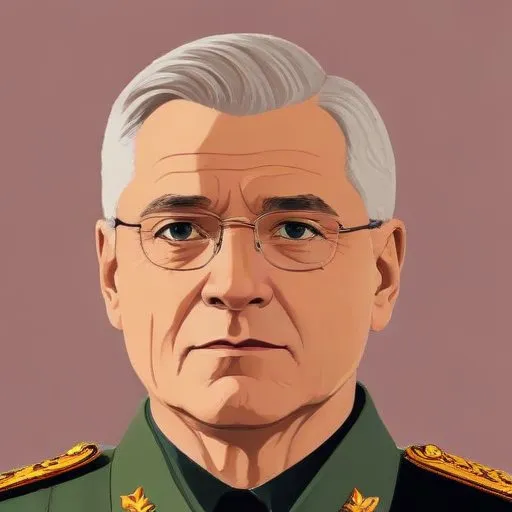
A high-ranking military officer who later became a prominent politician, known for his advocacy of disarmament and his role in the German peace movement.
Gert Bastian, a German military officer turned politician, is best known for his radical shift from a decorated war hero to a vocal critic of the military establishment, and his subsequent leadership in the peace movement. As a high-ranking officer in the Bundeswehr, Bastian's dissenting views on the deployment of nuclear missiles in Europe led to his resignation and later, the founding of Generals for Peace, a group that sought to promote disarmament and international cooperation.
Born on March 26, 1923, in Munich, Germany, Bastian volunteered for the Wehrmacht in 1941 at the age of 19. He served on the Eastern Front, where he was wounded multiple times, including by a bullet in the right arm and a grenade fragment in the head. After the war, he started a business, which eventually failed, leading him to rejoin the military.
Bastian's military career spanned over two decades, during which he rose through the ranks to become a Brigadier General and chief of staff in the army office. However, his experiences in World War II and his gradual disillusionment with the military establishment's policies led him to re-evaluate his values and ultimately, to become an advocate for peace.
In 1980, Bastian outlined his opposition to the deployment of medium-range missiles with nuclear warheads in Europe in a memorandum to the West German government. When his request to retire was rejected, he resigned from the military and joined the peace movement. The following year, he co-founded Generals for Peace, a group that sought to promote disarmament and international cooperation.
Bastian's partnership with Petra Kelly, a prominent peace activist, was a defining aspect of his later life. Together, they were prominent supporters of the opposition in the German Democratic Republic and worked tirelessly to promote peace and understanding between East and West.
In the 1990s, allegations surfaced that Generals for Peace was secretly financed and controlled by the Stasi, the East German secret police. While these claims were never substantiated, they have dogged Bastian's legacy and raised questions about the extent of Soviet influence on the peace movement.
Despite these controversies, Gert Bastian's courage to challenge the status quo and his commitment to promoting peace and disarmament remain an inspiration to many. His life serves as a testament to the power of individual conscience and the importance of standing up against injustice, even in the face of overwhelming opposition.
Gert Bastian's legacy continues to inspire generations of peace activists and human rights advocates. His courage to challenge the military establishment and his dedication to promoting peace and disarmament serve as a powerful reminder of the importance of individual action in creating a more just and peaceful world.
99 Years Old
A German statesman who served as Vice-Chancellor and Foreign Minister, playing a key role in reunifying Germany and shaping European politics. He's known for his diplomatic efforts and advocacy for human rights.
Born in 1918
A German leader who served as Chancellor from 1974 to 1982, known for his pragmatic and socially liberal policies, and his key role in shaping the European Union. He was also a respected economist and published author.
82 Years Old
The 7th Chancellor of Germany, a lawyer-turned-politician, led the country from 1998 to 2005, implementing significant economic and social reforms. He's known for his efforts to modernize Germany and strengthen the European Union.
72 Years Old
The first female Chancellor of Germany, serving for 16 years, known for her leadership during the European sovereign-debt crisis and her role in shaping the European Union's policy. She's a highly influential figure in modern politics.
Born in 1913
A German statesman who served as Chancellor of Germany, known for his efforts to reconcile with Eastern Europe and his "Ostpolitik" policy, earning him a Nobel Peace Prize.
Born in 1922
A key architect of Germany's Ostpolitik, he played a crucial role in shaping the country's foreign policy and relations with Eastern Europe during the Cold War era.
88 Years Old
The 11th President of Austria, a renowned academic and politician, served as the country's head of state from 2004 to 2016, known for promoting unity and stability. He's also a respected historian and law expert.
