


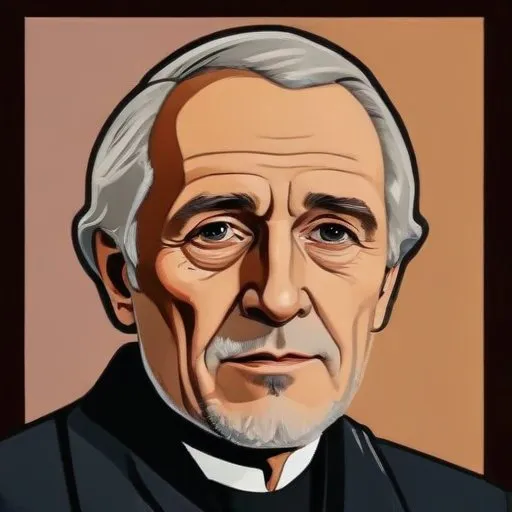
A 17th-century historian and theologian who wrote extensively on church history, challenging traditional views and sparking controversy with his critiques of Lutheranism. He's known for his objective, fact-based approach to historical research.
Gottfried Arnold, a German Lutheran theologian and historian, is renowned for his groundbreaking work, Kirchen und Ketzer Historie (Unpartheyische Impartial History of the Church and of Heresy), which challenged the traditional narrative of church history and sparked controversy among the orthodox clergy.
Published in two volumes between 1699 and 1700, Arnold's magnum opus presented a refreshingly nuanced and impartial account of church history, deviating from the conventional apologetic approach that often portrayed heretics as villainous figures. Instead, Arnold humanized these marginalized groups, highlighting the complex socio-political contexts that led to their rise and fall.
Born on September 5, 1666, in Annaberg, Saxony, Germany, Arnold was the son of a schoolmaster. He began his educational journey at the Gymnasium in Gera in 1682, later enrolling at the University of Wittenberg in 1685 to study theology and history.
It was during his time at Wittenberg that Arnold came under the influence of Philip Jacob Spener, the father of Pietism, who instilled in him a passion for theological inquiry and a critical approach to traditional dogma.
Aronold's first literary endeavor, Die Erste Liebe zu Christo (The First Love to Christ), published in 1696, earned him widespread recognition and acclaim, going through five editions by 1728.
This success led to his appointment as professor of church history at the University of Giessen in 1697. However, Arnold's disillusionment with academic politics and the stifling atmosphere of academic life prompted him to resign the following year, returning to Wittenberg to focus on his writing.
Aronold's most significant contribution lies in his reevaluation of heresy and its role in shaping church history. He argued that heresy was not a malevolent force, but rather a natural response to the rigid dogmatism and authoritarianism of the established Church.
He believed that the worst calamity in Church history was its establishment as the accepted and orthodox faith by the Roman Emperor Constantine in the fourth century, which led to the persecution of marginalized groups and the suppression of free thought.
Aronold's work had far-reaching implications, influencing thinkers like Leo Tolstoy, who praised his Kirchen und Ketzer Historie as a "remarkable" and "little-known" work in his book The Kingdom of God Is Within You.
Tolstoy's admiration for Arnold's work reflects the latter's ability to challenge traditional narratives and inspire new perspectives on religious history and its impact on modern society.
Gottfried Arnold's unconventional approach to church history has left an indelible mark on the field of theology and historical inquiry. His courage to question the status quo and humanize marginalized groups has inspired generations of scholars and thinkers.
As a testament to his legacy, Arnold's work continues to inspire new generations of scholars, ensuring that his contribution to our understanding of church history remains an integral part of our collective cultural heritage.
Born in 1483
A German monk and priest who sparked the Protestant Reformation, challenging Catholic Church authority and shaping Western Christianity. He's famous for nailing 95 theses to a church door, sparking a religious revolution.
Born in 1509
A French pastor and theologian who played a key role in the Protestant Reformation, shaping Christian theology and influencing Western civilization. He's famous for his teachings on predestination and his role in establishing Calvinism.
Born in 1484
Leader of the Swiss Reformation, advocating for church reform and inspiring other Protestant movements.
Born in 1497
A 16th-century Renaissance scholar who made significant contributions to the development of the Protestant Reformation and education, known for his theological writings and astronomical observations.
Born in 1499
A prominent figure in the Protestant Reformation, this theologian played a key role in shaping Lutheran theology and was a close associate of Martin Luther. He's also known for his biblical commentaries and liturgical reforms.
Born in 1498
A 16th-century theologian who sparked controversy by anonymously publishing a preface to Copernicus' De revolutionibus orbium coelestium, which led to a misunderstanding of the astronomer's heliocentric model. They also contributed to the development of Lutheran theology.
Born in 1520
A 16th-century Croatian theologian and reformer who played a key role in shaping the Lutheran Reformation, particularly through his writings on the nature of sin and justification. He's also known for his critical approach to biblical interpretation.
Born in 1485
A key figure in the Protestant Reformation, he played a crucial role in shaping Lutheran theology and was a close advisor to Martin Luther. He's also known for his work in establishing the Lutheran Church in Denmark and Norway.
