


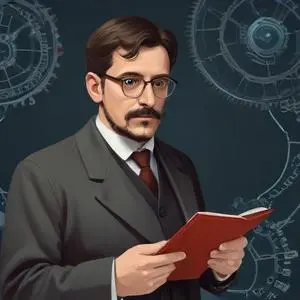
Formulated laws of electromagnetic induction, predicting how a changing magnetic field induces an electric field. His work laid the foundation for many modern technologies, including generators, motors, and transformers.
Lenz's most significant work was his 1834 publication, "On the Induction of Electric Currents," where he formulated Lenz's law. This law states that an induced current flows in a direction such that it opposes the change in the magnetic flux that induced it.
Lenz's law has far-reaching implications in various fields, including:
Lenz was a prolific researcher and published numerous papers throughout his career. Some notable events include:
Heinrich Lenz left an indelible mark on the field of electromagnetism. His work laid the foundation for the development of modern technologies, including generators, motors, and transformers.
The Lenz's law has been a cornerstone in the understanding of electromagnetic phenomena, and its implications continue to influence research and innovation in the field.
Today, Lenz's legacy is celebrated through the naming of various academic institutions, research centers, and awards in his honor.
Heinrich Lenz's groundbreaking work continues to inspire generations of scientists, engineers, and researchers. His legacy serves as a testament to the power of human curiosity and the importance of fundamental research.
As we continue to push the boundaries of knowledge and innovation, the contributions of pioneering figures like Lenz remind us of the significance of basic scientific research and its potential to transform our world.
Born in 1791
Pioneering scientist who discovered electromagnetic induction, formulated the laws of electrolysis, and invented the first electrical generator, revolutionizing our understanding of electricity and its applications.
Born in 1831
Developed groundbreaking theories that unified electricity and magnetism, and predicted the existence of radio waves, revolutionizing our understanding of the physical world.
Born in 1821
A 19th-century physician and physicist who made significant contributions to the fields of electromagnetism, thermodynamics, and the physiology of human perception, particularly in the study of vision and hearing.
Born in 1822
Developed the theory of thermodynamics, introducing the concept of entropy, and made significant contributions to the fields of electricity and magnetism.
Born in 1775
A pioneer in the field of electromagnetism, he formulated fundamental laws that describe the relationship between electric currents and magnetic fields. His work laid the foundation for many modern technologies, including electric motors and generators.
Born in 1789
Formulated laws governing the relationship between voltage, current, and resistance in electric circuits, revolutionizing the field of electrical engineering.
Born in 1777
A pioneer in mathematics and physics, he made major contributions to number theory, algebra, and electromagnetism, shaping our understanding of the natural world.
Born in 1804
Developed the first electromagnetic theory of light and made significant contributions to the understanding of electricity and magnetism. He's also credited with inventing the first electromagnetic telegraph.
