


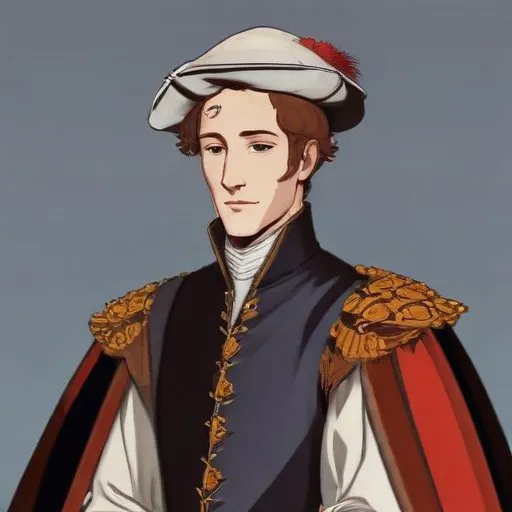
A powerful nobleman who played a significant role in the English Reformation and was a key figure in the Tudor court, known for his plots against Queen Elizabeth I.
Henry Howard, 6th Duke of Norfolk, was an English nobleman and politician who left an indelible mark on the aristocracy and the world of science. He is best known for his influential role in the Royal Society, his dedication to preserving his family's legacy, and his tumultuous personal life.
Henry Howard was born on July 12, 1628, to Henry Howard, 22nd Earl of Arundel, and Lady Elizabeth Stuart. He was the second son, and his older brother, Thomas, was destined to inherit the title of Duke of Norfolk. However, fate had other plans, and Thomas's mental disability, brought on by a fever contracted in Padua in 1645, led to Henry taking on a significant role in managing the duchy's affairs.
In 1660, Henry'sfamily's influence and persuasion led King Charles II to revive the Dukedom of Norfolk, with Henry's brother Thomas as the titular holder. However, due to Thomas's incapacitation, Henry effectively managed the duchy's affairs, earning him a reputation as a shrewd politician. His patronage extended to the Royal Society, which he allowed to meet regularly at Arundel House after the Great Fire of London in 1666.
Henry's political influence grew, and he was created 1st Baron Howard of Castle Rising in 1669 and 1st Earl of Norwich in 1672. These titles came with the restoration of the office of Earl Marshal of England to him and his family. He wielded significant power in the Lords, even finding a safe seat in Parliament for Samuel Pepys in 1673.
Henry's personal life was marked by controversy, particularly his marriage to Jane Bickerton, his long-time mistress. This union sparked a violent family quarrel, leading him to briefly flee abroad. Despite this, he remained a prominent figure in politics and society.
Henry Howard's legacy extends beyond his political achievements. He played a crucial role in preserving his family's cultural heritage, gifting Oxford University with his grandfather's Grecian statues and bestowing his grandfather's manuscript collection to the Royal Society. His patronage and support for the scientific community earned him a lasting place in history.
Henry Howard, 6th Duke of Norfolk, was a complex figure, marked by both controversy and contribution. His influence on politics, science, and culture continues to resonate, leaving behind a lasting legacy in the annals of English history.
Born in 1536
A powerful nobleman who served as Earl Marshal of the United Kingdom, known for his involvement in the Ridolfi Plot to assassinate Queen Elizabeth I. He was eventually executed for treason.
Born in 1491
A larger-than-life monarch who ruled England with an iron fist, infamous for his six marriages and the English Reformation.
Born in 1485
Spanish princess who became the queen consort of England, playing a central role in the English Reformation and sparking the creation of the Church of England.
Born in 1516
The first queen to rule England in her own right, Bloody Mary tried to restore Catholicism, earning her notorious reputation for burning hundreds of Protestants at the stake.
Born in 1533
The Virgin Queen, a powerful and beloved monarch, ruled England during a golden age of culture, literature, and exploration, establishing the Church of England and defeating the Spanish Armada.
Born in 1532
A powerful and charming favorite of Queen Elizabeth I, known for his influence on English politics and suspected involvement in the mysterious death of his wife.
