


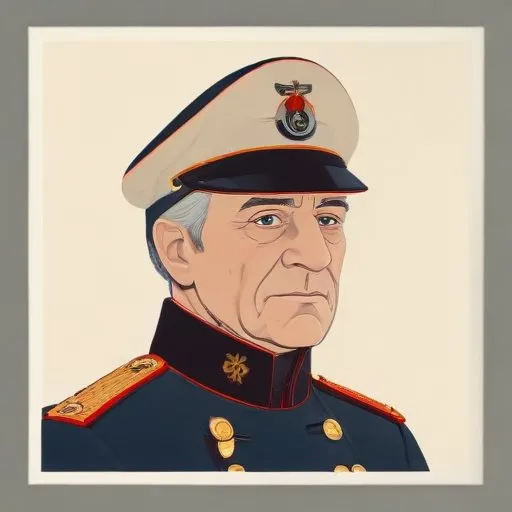
A highly decorated World War II tank commander, known for his tactical genius and innovative armored warfare strategies. He played a key role in several major battles, including the Battle of Stalingrad.
Hermann Balck is renowned for his exceptional bravery and tactical prowess as a highly decorated officer of the German Army during both World War I and World War II, rising to the rank of General der Panzertruppe. He is celebrated for his unwavering leadership and innovative approach to armored warfare, earning him the respect and admiration of his peers and enemies alike.
Born on December 7, 1893, in Danzig, Germany (present-day Wrzeszcz, Poland), Balck hailed from a family with a rich military tradition. His father, William Balck, was a senior officer in the Imperial German Army. Hermann's early life was marked by a strong sense of discipline and duty, which would eventually shape his remarkable military career.
On April 10, 1913, Balck entered the Hanoverian Rifle Battalion 10 in Goslar as a cadet, and later attended the Hanoverian Military College. His time at the college was cut short by the outbreak of World War I in August 1914.
During the interwar period, Balck was selected as one of the 4,000 officers to continue serving in the Reichswehr. He transferred to the 18th Cavalry Regiment in 1922, where he remained for 12 years. Notably, he twice declined a post in the German General Staff, opting instead to remain a line officer.
At the outbreak of World War II in 1939, Balck served in the Oberkommando des Heeres (OKH) as a staff officer in the Inspectorate of Motorized Troops, responsible for refitting and reorganizing the growing panzer forces.
Hermann Balck's remarkable military career spans two world wars, earning him a reputation as one of the most skilled and daring tank commanders of his time. His tactical genius, bravery, and leadership qualities have inspired generations of military officers and historians alike.
Today, Balck's legacy serves as a testament to the importance of innovative thinking, adaptability, and unwavering dedication to duty in the face of adversity.
Born in 1888
A pioneering tank commander who revolutionized modern warfare with his innovative blitzkrieg tactics, earning him the nickname "Father of the Panzerwaffe".
Born in 1887
A highly decorated military strategist who played a crucial role in several key battles during World War II, including the invasion of France and the Siege of Leningrad.
Born in 1880
A German field marshal who led the Wehrmacht during World War II, playing a key role in the invasion of Poland and the Battle of Moscow. He was a prominent figure in the German high command during the war.
Born in 1882
A high-ranking military officer who played a crucial role in World War II, particularly in the Battle of France and the plot to assassinate Adolf Hitler.
Born in 1891
A skilled and highly decorated military leader, known for his tactical genius and defensive strategies during World War II, earning him the respect of both his allies and enemies.
Born in 1876
A German naval leader who played a key role in the Kriegsmarine during World War II, overseeing the German U-boat fleet and naval operations. He was a close advisor to Adolf Hitler and implemented the German naval strategy during the war.
Born in 1891
A German naval commander who led the U-boat fleet during World War II and briefly served as President of Germany after Hitler's death, known for his role in the war and its aftermath.
