


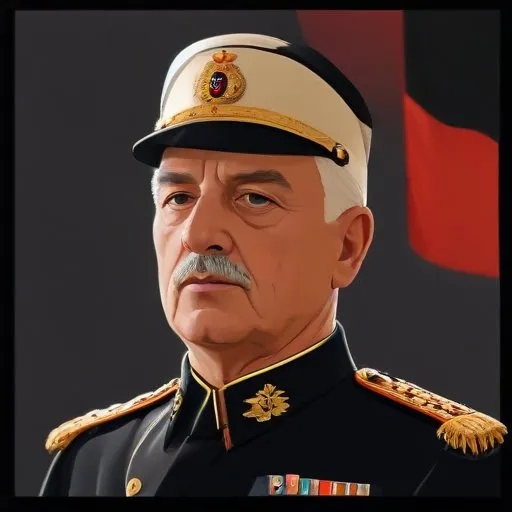
A high-ranking officer in the German Air Force during World War II, he played a crucial role in the Battle of Britain and was a key figure in the Luftwaffe's operations.
Hugo Sperrle is notorious for being one of the highest-ranking officers in the Luftwaffe, the aerial warfare branch of the German Wehrmacht, during World War II. He played a crucial role in the Battle of France and the Battle of Britain, earning him the nickname "The Butcher of Britain."
Born on February 7, 1885, in Bavaria, Germany, Sperrle joined the Imperial German Army in 1903. He served in the artillery during World War I, eventually joining the Luftstreitkräfte as an observer in 1914. He trained as a pilot and ended the war at the rank of Hauptmann (Captain) in command of an aerial reconnaissance attachment of a field army.
In the interwar period, Sperrle was appointed to the General Staff in the Reichswehr, serving the Weimar Republic in the aerial warfare branch. When the Nazi Party seized power in 1934, Sperrle was promoted to Generalmajor (Brigadier General) and transferred from the army to the Luftwaffe.
In November 1936, Sperrle was given command of the Condor Legion, an expeditionary force sent to support General Francisco Franco's Nationalist forces in the Spanish Civil War. He fought in Spain until October 1937, gaining valuable experience in aerial warfare.
In February 1938, Sperrle was appointed as commanding officer of Luftwaffengruppenkommando 3 (Air Force Group Command 3), the forerunner of Luftflotte 3 (Air Fleet 3). He played a crucial role in the Anschluss and Czech crisis, using his air fleet to threaten other governments with bombardment.
During World War II, Sperrle and his air fleet served exclusively on the Western Front. He was instrumental in the Battle of France and the Battle of Britain in 1940. In 1941, he directed operations during The Blitz, a sustained bombing campaign against Britain.
As the war turned against Germany, Sperrle's command was depleted in the battles of attrition. He was relieved of his command in 1944 and eventually surrendered to the Allies in 1945. Sperrle was tried and convicted of war crimes at the Nuremberg Trials, but was released from prison in 1953. He died on April 2, 1953, at the age of 68.
Hugo Sperrle's legacy is controversial, with some viewing him as a skilled military strategist and others condemning him as a war criminal. Despite his role in the devastation of World War II, Sperrle remains a significant figure in the history of aerial warfare.
Born in 1893
A high-ranking Nazi official, he was a decorated World War I fighter pilot and later became a prominent politician, serving as Minister President of Prussia. He's infamous for his role in the Nazi regime and war crimes trials.
Born in 1892
A highly decorated Luftwaffe pilot and commander, known for being the last commander of the Luftwaffe during World War II and flying Hitler out of Berlin in 1945.
Born in 1876
A German naval leader who played a key role in the Kriegsmarine during World War II, overseeing the German U-boat fleet and naval operations. He was a close advisor to Adolf Hitler and implemented the German naval strategy during the war.
Born in 1891
A German naval commander who led the U-boat fleet during World War II and briefly served as President of Germany after Hitler's death, known for his role in the war and its aftermath.
Born in 1888
A pioneering tank commander who revolutionized modern warfare with his innovative blitzkrieg tactics, earning him the nickname "Father of the Panzerwaffe".
Born in 1880
A German field marshal who led the Wehrmacht during World War II, playing a key role in the invasion of Poland and the Battle of Moscow. He was a prominent figure in the German high command during the war.
Born in 1882
A high-ranking Nazi officer who served as the Chief of the OKW, the German High Command, during World War II, and was known for his unwavering loyalty to Hitler. He was tried and executed for war crimes after the war.
Born in 1890
Chief of the German High Command during World War II, responsible for planning and executing military operations, and signing the unconditional surrender of Germany.
