


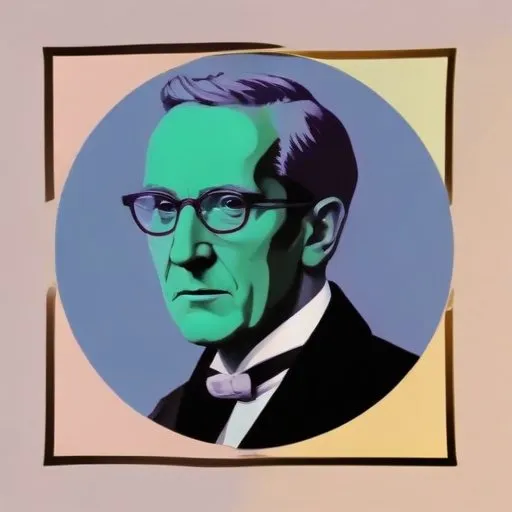
A mathematician and author who wrote influential textbooks on mathematics, particularly calculus and algebra, that were widely used in British schools during the 19th century. His works remained popular for many years, shaping the education of numerous mathematicians and scientists.
Isaac Todhunter, a renowned English mathematician, is best known for his extensive contributions to the field of mathematics and its rich history. His notable writings on mathematics have left an indelible mark, making him a prominent figure in the world of mathematics.
Born on November 23, 1820, in Rye, Sussex, Todhunter was the son of George Todhunter, a Nonconformist minister, and Mary Hume. Following his father's death in 1826, his mother established a school in Hastings, where Todhunter received his early education. He later attended schools run by Robert Carr and John Baptist Austin, eventually becoming an assistant master at a school in Peckham.
Todhunter's thirst for knowledge led him to attend evening classes at University College, London, where he was influenced by the prominent mathematician Augustus De Morgan. In 1842, he secured a mathematical scholarship and graduated as B.A. from London University, earning the gold medal on the M.A. examination.
In 1844, Todhunter entered St John's College, Cambridge, where he emerged as senior wrangler in 1848. He was awarded the first Smith's Prize and the Burney Prize in the same year. In 1849, he was elected to a fellowship, marking the beginning of his life as a college lecturer and private tutor.
Todhunter's impressive academic achievements continued to accumulate. In 1862, he was elected a fellow of the Royal Society, and in 1865, he became a member of the Mathematical Society of London. His remarkable work earned him the Adams Prize in 1871, and he was elected to the council of the Royal Society.
On August 13, 1864, Todhunter married Louisa Anna Maria, the eldest daughter of Captain George Davies, R.N. He resigned his fellowship in 1864 and went on to serve as an honorary fellow of St John's in 1874.
Todhunter's health began to decline in 1880, with his eyesight failing and a subsequent attack of paralysis. He passed away on March 1, 1884, at his residence in Cambridge, leaving behind a legacy that continues to inspire mathematicians and historians alike.
Isaac Todhunter's works on mathematics and its history have left an enduring impact on the field. His writings, which include books on algebra, geometry, and calculus, have been invaluable resources for students and scholars. Todhunter's contributions have not only enriched our understanding of mathematics but have also inspired future generations to pursue careers in this field.
In conclusion, Isaac Todhunter's remarkable career, marked by his academic achievements, contributions to mathematics, and historical writings, has cemented his position as a pioneer in the field. His legacy continues to inspire and educate, ensuring that his work remains relevant and valuable to this day.
Born in 1821
Developed the theory of matrices and introduced the concept of groups, revolutionizing abstract algebra and paving the way for modern mathematics.
Born in 1831
Developed groundbreaking theories that unified electricity and magnetism, and predicted the existence of radio waves, revolutionizing our understanding of the physical world.
Born in 1805
Developed groundbreaking theories in optics, algebra, and geometry, and is credited with discovering quaternions, a mathematical concept that paved the way for modern vector analysis.
Born in 1806
Developed the De Morgan's laws, which are fundamental principles in logic and set theory, and made significant contributions to the development of modern mathematics.
Born in 1815
Developed Boolean logic, a system of algebraic notation for logical operations that laid the foundation for modern computer science and electronic communication.
Born in 1815
Pioneering mathematician and computer scientist who wrote the first algorithm intended to be processed by a machine, and is often considered the first computer programmer. Her work on Charles Babbage's Analytical Engine envisioned its potential to go beyond mere calculation and perform any task that could be expressed in a series of steps.
Born in 1791
A pioneer in computer science, credited with inventing the first mechanical computer, the Difference Engine, and conceptualizing the Analytical Engine, a precursor to modern computers.
Born in 1791
Pioneering scientist who discovered electromagnetic induction, formulated the laws of electrolysis, and invented the first electrical generator, revolutionizing our understanding of electricity and its applications.
