


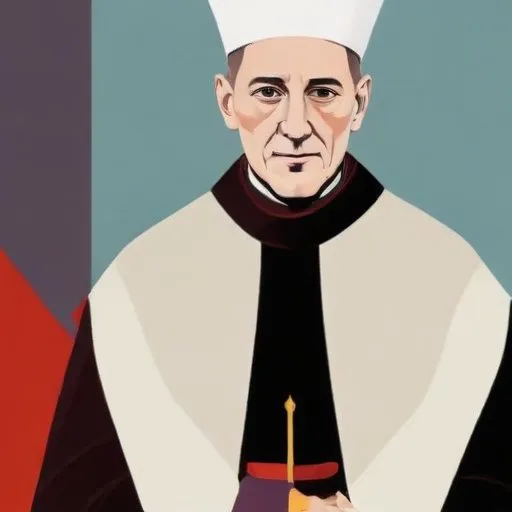
A French priest who compiled and published a vast collection of Christian texts, making them accessible to scholars and theologians. He is credited with preserving many ancient works that might have otherwise been lost.
Jacques Paul Migne was a French priest who revolutionized the world of theological studies by publishing inexpensive and widely distributed editions of theological works, encyclopedias, and the texts of the Church Fathers. His monumental project, the Patrologia Latina and Graeca, remains one of the most significant contributions to the scholarship of patristics and the Middle Ages in the 19th century.
Migne was born on October 25, 1800, in Saint-Flour, Cantal, France. He studied theology at the University of Orléans and was ordained as a priest in 1824. He was placed in charge of the parish of Puiseaux in the diocese of Orléans, where his strong Catholic and royalist sympathies often clashed with the local patriotism and the new regime of the Citizen-King.
In 1833, after a falling out with his bishop over a pamphlet he had published, Migne moved to Paris and started a journal called L'Univers religieux. The journal quickly gained 1,800 subscribers and Migne edited it for three years. He then went on to co-edit L'Univers with Louis Veuillot, which became an ultramontane organ.
In 1836, Migne founded the Ateliers catholiques, a publishing house that would become the hub of his publishing empire. He believed in the power of the press and the value of information widely distributed, and he worked tirelessly to publish numerous religious works in rapid succession. Migne's innovative approach to publishing included bypassing the traditional bookselling establishment and offering direct subscriptions to his works at prices that ensured wide circulation.
Migne's magnum opus, the Patrologia Latina and Graeca, is a monumental collection of theological works that showcased his dedication to making knowledge accessible to the Catholic priesthood. The Patrologia Latina, which spanned 217 volumes, contained the writings of the Church Fathers in Latin, while the Patrologia Graeca, which consisted of 161 volumes, featured the works of the Church Fathers in Greek.
These works, along with the Monumenta Germaniae Historica, are considered some of the most significant contributions to the scholarship of patristics and the Middle Ages in the 19th century. Migne's editions put many original texts into the hands of the priesthood for the first time, revolutionizing the study of theology and Catholicism.
Migne's work had a profound impact on the Catholic Church and the world of theological studies. His publishing empire made him a household name, and his works were widely distributed across Europe and beyond. His legacy extends far beyond his own lifetime, and his contributions to the field of patristics and medieval studies continue to be felt to this day.
In conclusion, Jacques Paul Migne was a visionary who dedicated his life to making knowledge accessible to the Catholic priesthood. His monumental contributions to the field of patristics and medieval studies continue to inspire and educate scholars to this day, cementing his place as one of the most important figures in the history of theological publishing.
Born in 1499
Reigned from 1559 to 1565, this Pope oversaw the final session of the Council of Trent, shaping Catholic doctrine and practice for centuries to come. He also commissioned the construction of the Sistine Chapel's dome.
Born in 1810
The first pope to fully embrace modernity, he issued the groundbreaking encyclical Rerum Novarum, which addressed social justice and workers' rights, shaping the Catholic Church's stance on social issues.
Born in 1554
Established the Congregation for the Propagation of the Faith, a missionary organization that aimed to spread Catholicism globally, and standardized the papal conclave process.
Born in 1876
The leader of the Catholic Church from 1939 to 1958, known for his controversial role during World War II, particularly in regards to the Holocaust. He is also remembered for his encyclicals on social justice and liturgical reforms.
Born in 1675
A 18th-century pope who reformed the Catholic Church, promoting tolerance and scholarship, and is known for his encyclicals on topics like usury and the sacraments.
Born in 1536
Led the Catholic Church during a tumultuous period, issuing papal bulls and playing a key role in the Counter-Reformation. He's also famous for his coffee habit, being the first Pope to try and approve of it.
Born in 1504
Leader of the Catholic Church during the Counter-Reformation, he excommunicated Queen Elizabeth I and played a key role in the Council of Trent.
Born in 1568
The 17th-century Catholic leader who reigned for 21 years, known for his strong stance against Galileo Galilei and his scientific discoveries, as well as his extensive patronage of the arts.
