


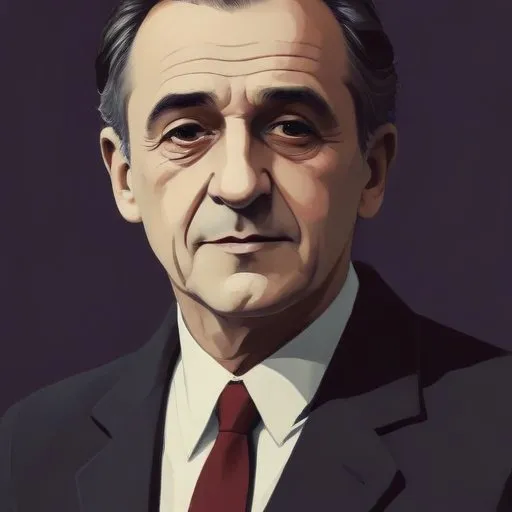
A French psychoanalyst and academic who developed the theory of "seduction" and its role in shaping human psyche, and wrote extensively on psychoanalytic theory and its applications.
Jean Laplanche, a French author, psychoanalyst, and winemaker, is renowned for his groundbreaking work on psychosexual development and Sigmund Freud's seduction theory. Through his writings, Laplanche delved deep into the human psyche, offering unique insights that continue to influence psychoanalytic theory to this day.
Born on June 21, 1924, in the Côte d'Or region of France, Laplanche was raised in a family that valued education and social justice. His adolescence was marked by active participation in Catholic Action, a left-wing social justice organization. This early exposure to social activism would later shape his philosophical views.
Laplanche's intellectual curiosity led him to the École Normale Supérieure in the 1940s, where he studied philosophy under the tutelage of Jean Hyppolite, Gaston Bachelard, and Maurice Merleau-Ponty. It was during this period that he became acquainted with the works of Sigmund Freud, which would later become a cornerstone of his psychoanalytic theories.
In 1943, during the Vichy regime, Laplanche joined the French Resistance, actively participating in Paris and Bourgogne. After the war, he spent a year at Harvard University, where he became fascinated with psychoanalytic theory. Instead of joining the university's philosophy department, he opted to study at the Department of Social Relations.
Upon his return to France, Laplanche began attending lectures by Jacques Lacan, a prominent psychoanalyst, and underwent psychoanalytic treatment under his guidance. This marked the beginning of Laplanche's journey into the world of psychoanalysis, which would eventually lead him to earn a doctorate in medicine and become an analyst himself.
Laplanche's most notable contributions to psychoanalytic theory include his work on the seduction theory and the concept of "afterwardsness" (Nachträglichkeit). He argued that the process of seduction is not limited to childhood experiences, but rather it is a continuous process that shapes our psyche throughout our lives.
Some of his notable books include:
From 1988 until his death, Laplanche served as the scientific director of the German-French translation project of Freud's complete works, Oeuvres Complètes de Freud (OCF.P). This monumental project, undertaken in collaboration with André Bourguignon, Pierre Cotet, and François Robert, aimed to provide a definitive translation of Freud's works.
Jean Laplanche's contributions to psychoanalytic theory have had a profound impact on modern thought. His work has influenced scholars, researchers, and practitioners across the globe, shaping the way we understand human development, seduction, and the human psyche.
As the scientific community continues to grapple with the complexities of human behavior, Laplanche's theories remain a beacon of insight, illuminating the intricate relationships between our conscious and unconscious minds.
Born in 1856
Pioneering psychoanalyst who developed theories on the subconscious mind, childhood experiences, and the structure of personality, revolutionizing our understanding of human behavior and psychology.
Born in 1901
A French psychiatrist and psychoanalyst who developed influential theories on the human psyche, particularly the concept of the "mirror stage" and the role of language in shaping our sense of self.
Born in 1905
Existentialist philosopher and playwright who argued that humans have complete freedom to choose their actions and create their own meaning in life, influencing modern thought on morality and individual responsibility.
Born in 1908
A French philosopher and academic who developed the concept of phenomenology, exploring the relationship between the self and the world, and is known for his work on perception, consciousness, and embodiment.
Born in 1913
A French philosopher and academic who developed influential theories on hermeneutics, phenomenology, and existentialism, and is known for his work on the philosophy of language and narrative.
Born in 1906
A Lithuanian-French philosopher who developed the concept of "ethics as first philosophy," emphasizing the importance of responsibility towards others and the face-to-face encounter. His work has influenced contemporary thought on morality, justice, and human rights.
Born in 1925
A psychiatrist and philosopher who wrote about the psychological effects of colonialism and racism, advocating for violent revolution to overthrow oppressive systems.
Born in 1918
A prominent 20th-century philosopher who developed the concept of "ideological state apparatuses" and reinterpreted Marxism, influencing modern social and political thought.
