


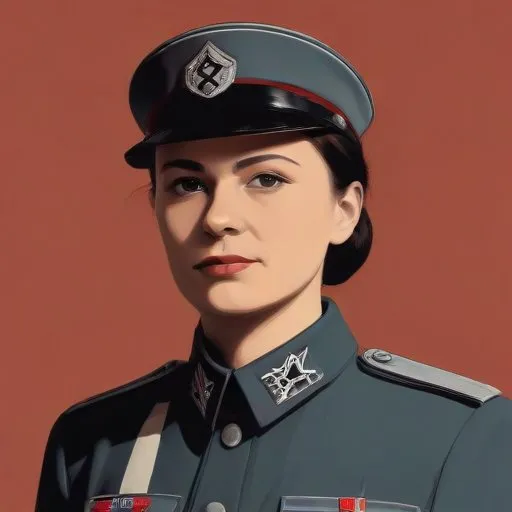
Johanna Langefeld, a notorious Nazi guard, is infamous for her role as a supervisor at three notorious Nazi concentration camps: Lichtenburg, Ravensbrück, and Auschwitz. Her involvement in the atrocities committed during the Holocaust has made her a significant figure in the history of Nazi Germany.
Born on May 5, 1900, in Kupferdreh, Germany, Johanna May was brought up in a Lutheran, nationalistic family. Her parents instilled in her and her sister the values of strict discipline and the traditional gender roles of "Kinder, Küche, Kirche" (Children, Kitchen, Church). After her husband's death in 1926, Langefeld worked as a teacher of domestic economy, which aligned with her traditional gender roles.
In 1935, Langefeld began working as a guard in a Arbeitsanstalt (working institution) in Brauweiler Abbey, a prison for women deemed "antisocial" by the Nazi regime. Her inability to conform to authority led to her dismissal, but it was during this time that she became an ardent supporter of Adolf Hitler, who promised to restore traditional gender roles.
In 1938, Langefeld applied for a job as a camp guard in the first Schutzstaffel (SS) concentration camp for women in Lichtenburg. She rapidly rose through the ranks, becoming the female superintendent of the camp, a position she held until the camp's population was relocated to Ravensbrück in 1939. Langefeld's involvement in the atrocities committed at these camps has been well-documented, and her brutality earned her a notorious reputation among inmates.
After the war, Langefeld was arrested and imprisoned for her role in the Holocaust. However, she managed to escape prison and was never brought to trial. Her fugitive status has made her a symbol of the impunity enjoyed by many Nazi war criminals.
Johanna Langefeld's legacy is one of horror and brutality. Her role in the Nazi regime's atrocities has left an indelible mark on history, serving as a stark reminder of the dangers of blind obedience and nationalist fervor. Despite escaping justice, Langefeld's actions will forever be remembered as a testament to humanity's capacity for evil.
Johanna Langefeld's story serves as a poignant reminder of the importance of holding individuals accountable for their actions, particularly those who have committed atrocities on a grand scale. While Langefeld may have escaped justice, her name will forever be synonymous with the horrors of the Holocaust.
Born in 1900
Leading the SS and Gestapo, he oversaw the Nazi regime's brutal security apparatus and implemented the "Final Solution," orchestrating the genocide of six million Jews during World War II.
Born in 1906
A high-ranking Nazi officer responsible for organizing the logistics of the Holocaust, overseeing the mass deportation of Jews to concentration camps during World War II.
Born in 1911
A notorious physician and captain who conducted inhumane experiments on prisoners, particularly twins, during the Holocaust, earning the nickname "Angel of Death".
Born in 1892
A ruthless and efficient administrator who oversaw the creation and operation of Nazi concentration camps during World War II, responsible for the deaths of millions of people.
Born in 1893
A high-ranking Nazi official, he was a decorated World War I fighter pilot and later became a prominent politician, serving as Minister President of Prussia. He's infamous for his role in the Nazi regime and war crimes trials.
Born in 1903
Austrian-German lawyer and general who served as the highest-ranking leader of the Nazi police forces, responsible for overseeing the Gestapo, SS, and concentration camps during World War II. He was a key figure in the Holocaust and other atrocities committed by the Nazi regime.
Born in 1894
A German sailor-turned-politician who played a key role in the Nazi regime, particularly in organizing forced labor during World War II. He was later tried and executed for war crimes.
Born in 1904
A high-ranking Nazi officer and physician who oversaw the Nazi euthanasia program, responsible for the deaths of thousands of people with mental and physical disabilities.
