


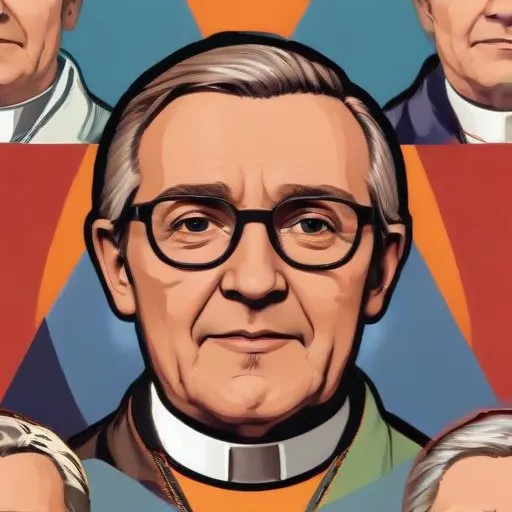
A prominent Catholic priest and theologian who played a key role in shaping the Second Vatican Council's Declaration on Religious Liberty, advocating for religious freedom and church-state separation.
John Courtney Murray was an American Jesuit priest and theologian renowned for his groundbreaking efforts to reconcile Catholicism with religious pluralism, and his profound impact on the relationship between religious freedom and democratic institutions. He is particularly celebrated for his instrumental role in shaping the Council's landmark Declaration on Religious Liberty, Dignitatis humanae, during the Second Vatican Council.
Born on September 12, 1904, in New York City, Murray entered the New York province of the Society of Jesus in 1920 after attending Xavier High School. He pursued classical and philosophical studies at Boston College, earning his bachelor's and master's degrees in 1926 and 1927, respectively.
Following his graduation, Murray traveled to the Philippines, where he taught Latin and English literature at the Ateneo de Manila. In 1930, he returned to the United States and was ordained a Roman Catholic priest in 1933. He then pursued advanced studies at the Gregorian University in Rome, earning a doctorate in sacred theology in 1937.
Upon his return to the United States, Murray joined the Jesuit theologate in Woodstock, Maryland, where he taught Catholic trinitarian theology. In 1940, he still firmly supported the Catholic doctrine that there was no salvation outside the Church. However, his subsequent work and writings revealed a growing commitment to interfaith dialogue and religious pluralism.
In 1941, Murray was appointed editor of the Jesuit journal Theological Studies, a position he held until his death. He also played a crucial role as a consultant to the religious affairs section of the Allied High Commission, contributing to the drafting and promotion of the 1943 Declaration on World Peace, an interfaith statement of principles for post-war reconstruction.
Murray's most enduring legacy is the Declaration on Religious Liberty, Dignitatis humanae, adopted by the Second Vatican Council in 1965. This groundbreaking document recognized the fundamental human right to religious freedom, marking a significant shift in the Catholic Church's stance on religious pluralism and democratic values.
Murray's theological and philosophical contributions were rooted in his commitment to the principles of human dignity, religious freedom, and democratic values. He believed that the Catholic Church must engage in open and respectful dialogue with other faiths and philosophies, acknowledging the inherent value of religious pluralism in a democratic society.
Murray's work has had a profound impact on modern society, shaping the Catholic Church's engagement with democratic institutions and influencing interfaith dialogue. His legacy continues to inspire theologians, scholars, and policymakers working towards a more inclusive and pluralistic understanding of religious freedom and human dignity.
"The dignity of the human person, as a creature of God, is the foundation of all civil and political rights."
"Religious freedom is not a privilege granted by the state, but a fundamental human right that belongs to every person by virtue of their humanity."
John Courtney Murray's life was marked by a deep commitment to his faith, his work, and his fellow human beings. His tireless efforts to reconcile Catholicism with religious pluralism and democratic values have left an indelible mark on modern society, inspiring future generations to work towards a more just and inclusive world.
Born in 1917
The 35th President of the United States was a charismatic leader who navigated the country through the Cuban Missile Crisis and advocated for civil rights, leaving a lasting legacy in American politics.
Born in 1882
A 20th-century philosopher and author who developed a philosophy of existence and the human person, integrating Thomistic and existentialist thought. His work had significant influence on Catholic intellectuals and the development of Christian philosophy.
Born in 1904
A German priest and theologian who sought to reconcile Catholicism with modern philosophy, exploring the intersection of faith and reason. His work greatly influenced 20th-century Catholic theology.
98 Years Old
A prominent Catholic theologian and prolific author, known for his progressive views on Christianity and criticism of the Catholic Church's authority. He wrote extensively on theology, ethics, and politics.
Born in 1417
A 15th-century pope who played a significant role in the fall of the Western Schism, ending the division in the Catholic Church. He's also known for his lavish spending and nepotism.
Born in 1881
Reformed the Catholic Church, introducing progressive reforms and ecumenical dialogue, and convened the Second Vatican Council.
Born in 1897
A pioneering social activist and journalist who advocated for pacifism, women's rights, and the poor, founding the Catholic Worker Movement to promote social justice and nonviolence.
