


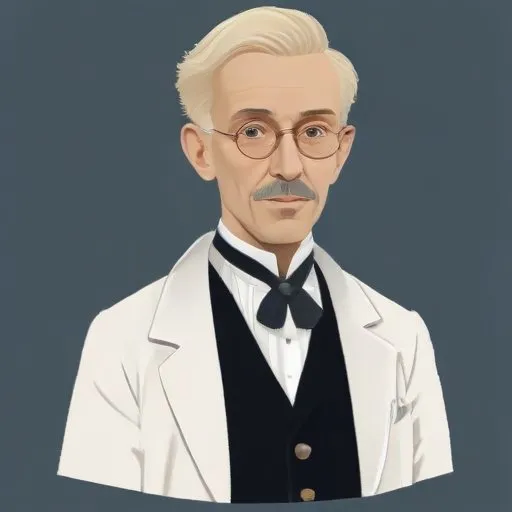
Pioneering researcher who isolated and characterized several hormones, including adrenaline, and developed the first successful treatment for diabetes. His work laid the foundation for modern endocrinology.
John Jacob Abel is renowned for being America's first full-time professor of pharmacology, establishing the pharmacology department at Johns Hopkins University School of Medicine in 1893. He is also credited with making groundbreaking discoveries in hormone extraction, revolutionizing the field of biochemistry and pharmacology.
John Jacob Abel was born on May 19, 1857, near Cleveland, Ohio, to George M. and Mary Becker Abel. He earned his Bachelor of Philosophy from the University of Michigan in 1883, where he studied under Henry Sewall. However, he took a detour to serve as a principal of a high school in La Porte, Indiana, teaching subjects ranging from chemistry and physics to Latin.
Abel's thirst for knowledge led him to Johns Hopkins University, where he studied under Henry Newell Martin, a cardiac physiologist and professor of biology. He then traveled to Europe, starting in Leipzig, where he studied medical sciences, and later to Strasbourg, where he received his M.D. in 1888 from the University of Strasbourg.
After completing his doctorate, Abel worked extensively in clinical studies and took clinical courses, focusing on biochemistry and pharmacology. His travels across Europe, particularly in Germany and central Europe, allowed him to conduct research in biochemistry and pharmacology.
Abel's most notable contributions include:
Abel's work had a profound impact on modern medicine, particularly in the fields of biochemistry and pharmacology. His discoveries and contributions continue to influence medical research and practice to this day.
He is also credited with inspiring a new generation of scientists, including the likes of Wendell H. Griffith, who went on to become a prominent biochemist in his own right.
Abel's life was marked by a thirst for knowledge and a passion for discovery. He was mentored by some of the greatest minds of his time, including Ludwig von Frey, Rudolf Boehm, Adolph Strmpell, and Johannes Wislicenus.
Throughout his life, Abel was driven by a desire to make a meaningful contribution to the field of biochemistry and pharmacology. His dedication and perseverance led him to become one of the most respected figures in his field.
John Jacob Abel's legacy extends far beyond his own lifetime. He will be remembered as a pioneer in the fields of biochemistry and pharmacology, a trailblazer who paved the way for future generations of scientists.
His contributions to medical research and practice continue to inspire and influence scientists today, cementing his place in the annals of medical history.
Born in 1852
A German chemist and academic who won the Nobel Prize for synthesizing amino acids and sugars, and establishing the structure of purines, revolutionizing the field of organic chemistry.
Born in 1860
A pioneer in biochemistry, he discovered that yeast extracts can ferment sugar without living yeast cells, laying the foundation for modern industrial fermentation processes. His work revolutionized the production of beer, wine, and bread.
Born in 1868
Discovered blood types and developed a system for classifying them, revolutionizing blood transfusions and saving countless lives. Pioneering work in immunology and serology also shed light on disease mechanisms.
Born in 1898
A high-ranking officer in the German Wehrmacht during World War II, known for his involvement in the July 20 plot to assassinate Adolf Hitler.
Born in 1905
A pioneering biochemist who discovered the mechanism of RNA synthesis, earning a Nobel Prize in Physiology or Medicine in 1959. His work laid the foundation for our understanding of genetic code and protein synthesis.
Born in 1918
Pioneering biochemist who discovered the mechanism of DNA replication and was awarded the Nobel Prize in Physiology or Medicine in 1959 for his groundbreaking work on nucleic acid synthesis.
Born in 1896
A pioneering scientist who discovered how the body breaks down and uses carbohydrates, earning a Nobel Prize in Physiology or Medicine in 1947. Her groundbreaking work has led to a deeper understanding of diabetes and other metabolic disorders.
