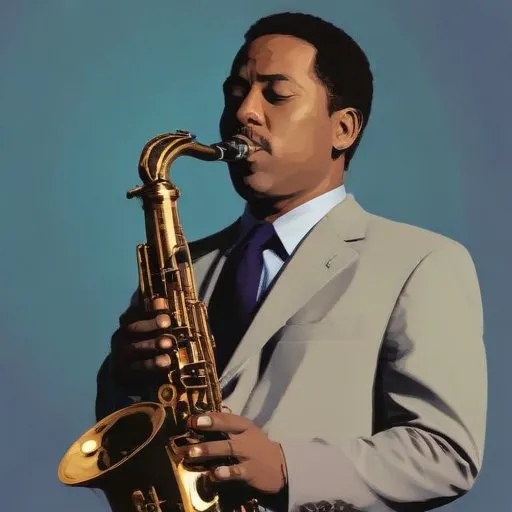
Johnny Griffin: The Little Giant of Jazz
A Force to be Reckoned With in Hard Bop
Johnny Griffin, affectionately known as the "Little Giant," was an American jazz tenor saxophonist who left an indelible mark on the jazz scene. With a career spanning over five decades, Griffin was a pioneering figure in hard bop, recording prolifically as a bandleader, and collaborating with jazz greats such as
Thelonious Monk,
Art Blakey, and Eddie "Lockjaw" Davis.
Early Life and Career
Born John Arnold Griffin III on April 24, 1928, in Chicago, Illinois, Griffin's musical journey began at DuSable High School, where he studied music under the tutelage of Walter Dyett. Starting out on clarinet, Griffin later shifted to oboe and finally settled on alto saxophone. His talent was evident from an early age, and at just 15, he began playing with
T-Bone Walker in a band led by Walker's brother.
Rise to Prominence
After graduating from high school, Griffin joined
Lionel Hampton's big band, where he was encouraged to take up the tenor saxophone. This marked a turning point in his career, and he soon became an integral part of Hampton's band, recording with them in 1945 at the age of 17. Griffin's playing can be heard on early rhythm and blues recordings for Atlantic Records, and by the early 1950s, he was playing baritone saxophone in an R&B septet led by Arnett Cobb.
Collaborations and Milestones
Griffin's collaboration with Thelonious Monk in the late 1950s resulted in some of his most iconic work. Monk, who was instrumental in Griffin's signing with Blue Note Records, praised Griffin's virtuosity, saying, "He's the greatest." Griffin's stint with Art Blakey's Jazz Messengers in 1957 further solidified his reputation as one of the premier saxophonists of his era. He also formed a memorable partnership with fellow tenor saxophonist
Eddie "Lockjaw" Davis, with whom he recorded several albums.
International Acclaim and Honors
In the 1960s, Griffin moved to Europe, where he became a key member of the
Kenny Clarke-Francy Boland Big Band. This move marked a new chapter in his career, as he began to gain international recognition. In 1995, Griffin was awarded an Honorary Doctorate of Music from Berklee College of Music, a testament to his contributions to the world of jazz.
Legacy
Johnny Griffin's legacy extends far beyond his impressive discography. He was a true master of his craft, and his influence can be heard in the playing of numerous jazz saxophonists. Griffin's virtuosity, tone, and phrasing have inspired generations of musicians, cementing his place as one of the greatest jazz saxophonists of all time.
- "The way he played was so forceful and so swinging, it was like a tidal wave." - Eddie "Lockjaw" Davis
- "He's the greatest." - Thelonious Monk
Awards and Honors
* Honorary Doctorate of Music, Berklee College of Music (1995)
Diskography
- A Blowing Session (1957)
- The Congregation (1957)
- Johnny Griffin Sextet (1958)
- Way Out! (1959)
- The Little Giant (1959)
Johnny Griffin's life was a testament to the power of dedication, hard work, and passion. As the "Little Giant" of jazz, he left an indelible mark on the genre, inspiring generations of musicians to come.
FAQ
What was Johnny Griffins early life and career like?
Johnny Griffin was born on April 24, 1928, in Chicago, Illinois. He began playing the saxophone at age 15 and went on to study music at the DuSable High School. Griffin served in the U.S. Army during the Korean War and later moved to New York City to pursue a music career.
What was Johnny Griffins style as a saxophonist?
Griffin was known for his aggressive and virtuosic playing style, characterized by rapid-fire phrasing and a strong, full-bodied tone. He was influenced by saxophonists such as Charlie Parker and Sonny Rollins.
What were Johnny Griffins most notable recordings?
Griffin recorded extensively as a leader and sideman, appearing on albums by Thelonious Monk, Art Blakey, and others. His notable recordings include A Blowin Session (1957) and The Congregate (1957).
How did Johnny Griffins playing style evolve over time?
Griffins playing became more introspective and melodic in the latter part of his career, as he explored new harmonic and rhythmic approaches. He continued to perform and record until his death in 2008.
What is Johnny Griffins legacy in jazz?
Griffin is remembered as one of the most formidable saxophonists in jazz history, known for his technical mastery and boundless energy. He inspired generations of saxophonists, including Sonny Rollins and Michael Brecker.