


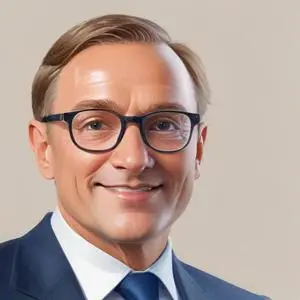
Co-founder of the global discount supermarket chain Aldi, revolutionizing retail with efficient logistics and low prices, making quality products accessible to the masses.
Karl Albrecht, the founder of Aldi, revolutionized the retail industry by introducing a discount supermarket chain that disrupted traditional business models. With his brother Theo, he created a shopping experience that would become synonymous with affordability and efficiency, earning him the title of richest person in Germany for many years.
Born on February 20, 1920, in Essen, Germany, Karl Albrecht grew up in a Catholic family with modest means. His father, Karl Sr., worked as a miner and later as a baker's assistant, while his mother Anna ran a small grocery store in the workers' quarter of Schonnebeck.
Karl served in the Wehrmacht during World War II and was wounded on the Eastern Front. After the war, he and his brother Theo took over their mother's business, jointly founding Albrecht KG.
In 1960, a disagreement over selling cigarettes in their stores led to a division between the brothers. Theo advocated for selling cigarettes, while Karl expressed concerns about attracting shoplifters. This led to the creation of two separate groups: Aldi Nord (north of the Ruhr) and Aldi Süd (south of the Ruhr). Karl's Aldi Süd went on to become the iconic discount supermarket chain.
Karl Albrecht's leadership and vision transformed the retail landscape. He introduced efficiency measures, such as minimizing product selection, reducing advertising, and using simple store layouts, which enabled Aldi to offer low prices and rapid growth. By 1962, the first Aldi store was opened, marking the beginning of a global phenomenon.
Although Karl Albrecht shied away from public life, he made significant philanthropic contributions. He founded the Karl Albrecht Stiftung, a charitable organization focused on supporting education, science, and social welfare initiatives. Despite his reclusive nature, Albrecht's impact on modern society cannot be overstated.
By 2014, Karl Albrecht's net worth was estimated to be over $20 billion, ranking him the 21st richest person in the world, according to the Hurun Report. His entrepreneurial ventures created thousands of jobs and generated revenue in the billions.
Despite his remarkable success, Albrecht faced criticism for his reclusive nature and controversies surrounding Aldi's business practices. Nevertheless, his legacy as a pioneering entrepreneur and visionary in the retail industry remains unchallenged.
Karl Albrecht married and had two children, although details about his personal life remain scarce due to his reclusive nature. He passed away on July 16, 2014, leaving behind a legacy that continues to shape the retail industry.
Karl Albrecht's Aldi revolutionized the way people shop, making high-quality products accessible at affordable prices. His innovative approach has inspired countless entrepreneurs and continues to shape the retail landscape.
In conclusion, Karl Albrecht's remarkable journey from humble beginnings to founding a global retail empire is a testament to his vision, perseverance, and entrepreneurial spirit. His legacy continues to inspire and influence modern society, cementing his place as one of the most important figures in retail history.
Born in 1918
A German leader who served as Chancellor from 1974 to 1982, known for his pragmatic and socially liberal policies, and his key role in shaping the European Union. He was also a respected economist and published author.
82 Years Old
The 7th Chancellor of Germany, a lawyer-turned-politician, led the country from 1998 to 2005, implementing significant economic and social reforms. He's known for his efforts to modernize Germany and strengthen the European Union.
72 Years Old
The first female Chancellor of Germany, serving for 16 years, known for her leadership during the European sovereign-debt crisis and her role in shaping the European Union's policy. She's a highly influential figure in modern politics.
Born in 1876
Led post-war West Germany's reconstruction and served as a key figure in shaping the country's modern identity, earning him the title "Father of the Federal Republic."
Born in 1897
The second Chancellor of West Germany, a key figure in the country's post-war economic miracle, known for his liberal economic policies and leadership during a period of rapid growth and reconstruction.
Born in 1913
A German statesman who served as Chancellor of Germany, known for his efforts to reconcile with Eastern Europe and his "Ostpolitik" policy, earning him a Nobel Peace Prize.
96 Years Old
The first unified Germany's leader, who oversaw the country's reunification after the Berlin Wall's fall, and is credited with creating a strong, stable economy.
