


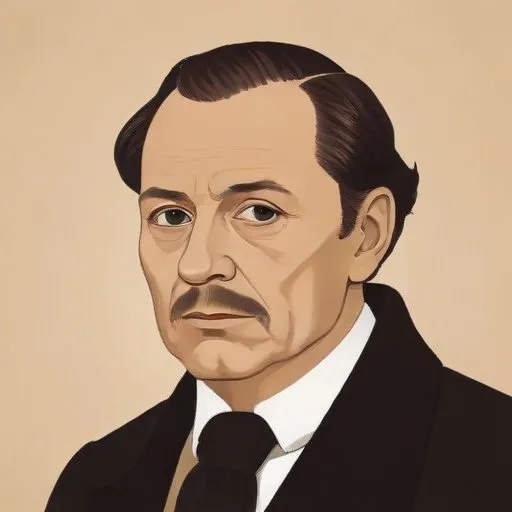
A German Romantic poet and critic who played a key role in shaping literary theory and criticism, known for his innovative ideas on poetry, art, and philosophy.
Karl Wilhelm Friedrich Schlegel, a German philosopher, poet, and literary critic, is renowned for his groundbreaking contributions to Romantic literary theory, which transformed the way literature was perceived and analyzed in the 19th century. His innovative ideas and critiques not only shaped the literary landscape of his time but also continue to influence contemporary literary criticism and theory.
Born on March 10, 1772, in Hanover, Germany, Schlegel was the youngest of five sons to Johann Adolf Schlegel, a Lutheran pastor. He studied law and literature at the University of Göttingen, where he developed a passion for philosophy, particularly the works of Immanuel Kant. In 1794, he transferred to the University of Leipzig, where he earned his degree in philosophy.
In 1798, Schlegel co-founded the literary magazine Athenaeum, which became the leading organ of German Romanticism. Alongside his brother August Wilhelm Schlegel, Friedrich Schleiermacher, and other prominent writers, Schlegel used the magazine as a platform to promote his revolutionary ideas on literature, aesthetics, and philosophy. During this period, he developed his theories on the romantic, the sublime, and the role of the poet in society.
Schlegel's most significant philosophical contribution is his Fragment theory, which posits that a work of literature is not a complete, autonomous entity but rather a fragment of a larger, infinite whole. This theory challenged traditional notions of literary unity and coherence. He also developed the concept of irony, which he believed was essential to romantic literature, as it allows the poet to express the inexpressible and convey the contradictions of human experience.
Schlegel's ideas have had a profound impact on modern literary theory, influencing thinkers such as Friedrich Nietzsche, Martin Heidegger, and Hans-Georg Gadamer. His emphasis on the importance of irony, the sublime, and the role of the poet in society has shaped the development of Romanticism, Symbolism, and Modernism.
Schlegel's personal life was marked by turmoil and controversy. He converted to Catholicism in 1808, which sparked a heated debate among his Protestant contemporaries. His relationship with his wife, Dorothea Veit, a novelist and intellectual in her own right, was marked by periods of separation and reconciliation.
Karl Wilhelm Friedrich Schlegel's innovative ideas and critiques have secured his place as one of the most important figures in German literary history. His romantic literary theory, fragment theory, and concept of irony continue to influence literary criticism, theory, and aesthetics, ensuring his legacy as a pioneer of Romanticism.
In conclusion, Karl Wilhelm Friedrich Schlegel's groundbreaking contributions to Romantic literary theory, philosophy, and aesthetics have left an indelible mark on the literary landscape. His ideas continue to inspire and influence scholars, writers, and thinkers to this day, solidifying his position as a giant of literary history.
Born in 1749
A German literary giant who penned iconic works like "Faust" and "The Sorrows of Young Werther", shaping the Romantic movement and influencing countless writers.
Born in 1759
A renowned poet and playwright who crafted influential works that explored the human condition, morality, and the struggle for freedom, leaving a lasting impact on German literature.
Born in 1724
Developed influential philosophical frameworks, such as the Critique of Pure Reason, that shaped modern Western thought on ethics, morality, and human understanding.
Born in 1770
A German philosopher and academic who developed a comprehensive and systematic philosophy that emphasized the unity of all things and the dialectical process of thesis, antithesis, and synthesis. His ideas have had a profound impact on modern thought, influencing fields such as philosophy, politics, and art.
Born in 1788
A pessimistic philosopher who wrote about the human condition, emphasizing the struggles and sufferings of life, and is famous for his concept of the "will to life".
Born in 1729
A prominent Enlightenment thinker, he's known for his influential writings on philosophy, literature, and theology, which helped shape modern German culture. He's also credited with developing the concept of dramatic irony in literature.
53 Years Old
A Jamaican artist who blends dancehall, reggae, and pop to create infectious hits, known for his energetic stage presence and chart-topping singles like "Gimme the Light" and "Baby Boy".
