


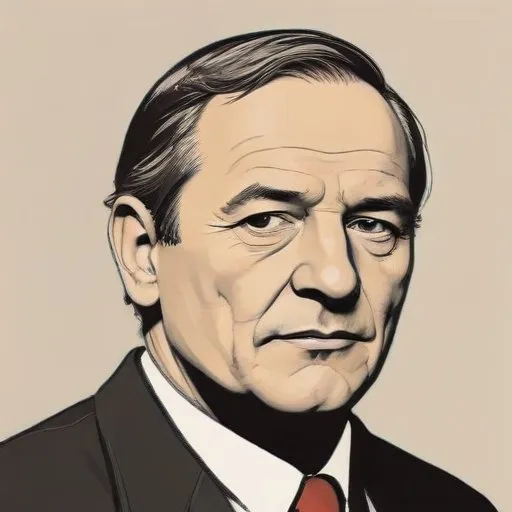
A German politician who served as Mayor of Hamburg and Federal Minister of Justice, known for his efforts to rebuild and reform post-war Germany.
Klaus von Dohnanyi is renowned for his remarkable talent as a German conductor, pianist, and administrator, who has left an indelible mark on the world of classical music. As a champion of cultural exchange, he has brought together some of the most esteemed musicians and ensembles, fostering a spirit of collaboration and artistic innovation.
Born on June 2, 1942, in Hamburg, Germany, Klaus von Dohnanyi was immersed in a rich cultural heritage from a young age. His father, Hans von Dohnanyi, was a German jurist and politician who played a significant role in the German Resistance during World War II. Klaus's mother, Christine von Dohnanyi, was a talented musician who instilled in him a love for music. He began his musical journey with piano lessons at the age of five and later pursued conducting studies at the Hochschule für Musik und Theater in Munich.
Von Dohnanyi's conducting career took off in the 1960s, with positions at the Frankfurt Opera and the Hamburg State Opera. He quickly gained recognition for his dynamic and expressive performances, which often featured innovative programming and collaborations with acclaimed soloists. His tenure as the General Music Director of the Frankfurt Opera (1977-1984) was marked by a series of critically acclaimed productions, including the premiere of Karlheinz Stockhausen's Licht cycle.
Von Dohnanyi's passion for cultural exchange has led to numerous groundbreaking projects and initiatives. As the Artistic Director of the Tokyo Philharmonic Orchestra (1984-1994), he introduced Japanese audiences to a diverse range of repertoire, from Bach to Boulez. His work with the Cleveland Orchestra (1984-2002) was characterized by a commitment to commissioning new works and promoting American composers.
Von Dohnanyi's artistic philosophy is rooted in a deep respect for the cultural heritage of classical music, while also embracing innovation and experimentation. He has spoken extensively about the importance of community engagement and arts education, believing that music has the power to break down cultural and social barriers.
Von Dohnanyi has been married to the German actress and writer, Annemarie Düringer, since 1968. The couple has two children, Justus and Anna. Throughout his life, he has remained committed to his family and has often credited his wife with providing inspiration and support throughout his career.
Klaus von Dohnanyi's tireless advocacy for cultural exchange, innovative programming, and community engagement has left a lasting impact on the world of classical music. As a champion of artistic collaboration, he has inspired generations of musicians, administrators, and audiences alike, ensuring that the rich cultural heritage of classical music continues to evolve and thrive.
In conclusion, Klaus von Dohnanyi's remarkable career serves as a testament to the transformative power of music, bridging cultural divides, and fostering a spirit of innovation and collaboration. As a visionary conductor, administrator, and advocate, he has left an indelible mark on the world of classical music, ensuring that his legacy will continue to inspire and enrich the lives of music lovers for generations to come.
96 Years Old
The first unified Germany's leader, who oversaw the country's reunification after the Berlin Wall's fall, and is credited with creating a strong, stable economy.
82 Years Old
The 7th Chancellor of Germany, a lawyer-turned-politician, led the country from 1998 to 2005, implementing significant economic and social reforms. He's known for his efforts to modernize Germany and strengthen the European Union.
72 Years Old
The first female Chancellor of Germany, serving for 16 years, known for her leadership during the European sovereign-debt crisis and her role in shaping the European Union's policy. She's a highly influential figure in modern politics.
99 Years Old
A German statesman who served as Vice-Chancellor and Foreign Minister, playing a key role in reunifying Germany and shaping European politics. He's known for his diplomatic efforts and advocacy for human rights.
Born in 1913
A German statesman who served as Chancellor of Germany, known for his efforts to reconcile with Eastern Europe and his "Ostpolitik" policy, earning him a Nobel Peace Prize.
Born in 1918
A German leader who served as Chancellor from 1974 to 1982, known for his pragmatic and socially liberal policies, and his key role in shaping the European Union. He was also a respected economist and published author.
Born in 1904
A German lawyer and politician who served as Chancellor of Germany from 1966 to 1969, known for his role in rebuilding post-war Germany and his efforts to come to terms with the country's Nazi past.
