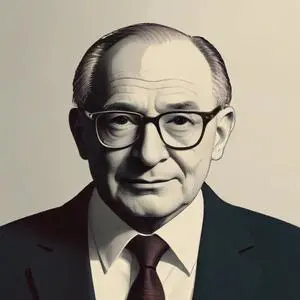
Leonid Hurwicz: The Visionary Economist and Game Theory Pioneer
A Nobel Laureate's Enduring Legacy in Mechanism Design
Leonid Hurwicz, the Polish-American economist and mathematician, is best known for his groundbreaking work in game theory and mechanism design. He is celebrated for originating the concept of incentive compatibility, demonstrating how desired outcomes can be achieved by using incentive-compatible mechanism design.
Early Life and Education
Born on August 21, 1917, in Moscow, Russia, to a family of Polish Jews, Hurwicz's early life was marked by turmoil. He returned to Warsaw with his family soon after his birth, only to face persecution by both the Bolsheviks and Nazis. In 1939, he became a refugee in the United States after Germany invaded Poland.
Academic Pursuits and Career Highlights
Hurwicz's educational journey took him to the University of Chicago, where he earned his Ph.D. in 1945. He worked as a research assistant for
Paul Samuelson at MIT and Oskar Lange at the University of Chicago. In 1946, he became an associate professor of economics at Iowa State College and later joined the University of Minnesota in 1951. He became Regents Professor of Economics in 1969 and Curtis L. Carlson Professor of Economics in 1989.
Major Contributions and Works
Hurwicz's seminal work on mechanism design earned him the 2007 Nobel Memorial Prize in Economic Sciences, which he shared with Eric Maskin and
Roger Myerson. His research focused on:
- Game theory and its applications to economics and social sciences
- Mechanism design and incentive compatibility
- Interactions between individuals and institutions, markets, and trade
Awards and Honors
Apart from the Nobel Memorial Prize, Hurwicz received numerous awards and honors for his contributions to economics and game theory, including:
- National Medal of Science (1990)
- Fellow of the American Academy of Arts and Sciences
- Fellow of the Econometric Society
Personal Life and Milestones
Hurwicz's personal life was marked by significant milestones, including his experience as a refugee during World War II. He passed away on June 24, 2008, at the age of 90, leaving behind a legacy that continues to inspire economists and game theorists worldwide.
Legacy and Impact
Hurwicz's work has had a profound impact on modern society, influencing fields such as:
- Economics and game theory
- Policy-making and mechanism design
- Social sciences and human behavior
His concepts of incentive compatibility and mechanism design continue to shape our understanding of interactions between individuals and institutions, markets, and trade. As one of the oldest Nobel Laureates, Hurwicz's legacy serves as a testament to the power of dedication, perseverance, and visionary thinking.
FAQ
What was Leonid Hurwiczs most significant contribution to economics?
Leonid Hurwiczs most significant contribution to economics was his work on mechanism design theory, which studies the design of economic mechanisms and institutions.
How did Leonid Hurwiczs work on mechanism design theory influence economic policy?
Leonid Hurwiczs work on mechanism design theory influenced economic policy by providing a framework for designing economic institutions and mechanisms that promote efficiency and fairness.
What awards and honors did Leonid Hurwicz receive for his contributions to economics?
Leonid Hurwicz was awarded the Nobel Memorial Prize in Economic Sciences in 2007, along with Eric Maskin and Roger Myerson, for his work on mechanism design theory.
How did Leonid Hurwiczs work on general equilibrium theory influence modern economics?
Leonid Hurwiczs work on general equilibrium theory influenced modern economics by providing a rigorous mathematical framework for understanding the behavior of economic systems.
What was Leonid Hurwiczs approach to economics and how did it differ from others?
Leonid Hurwiczs approach to economics was characterized by his emphasis on mathematical rigor and his focus on the design of economic mechanisms and institutions, which differed from other approaches that focused on macroeconomic policy or microeconomic behavior.