


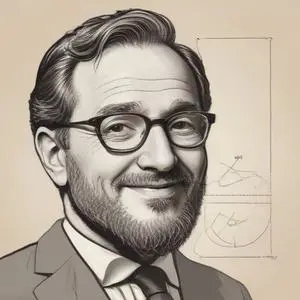
Developed game theory models to understand human behavior and decision-making, earning a Nobel Prize in Economics in 2007.
Roger Myerson is renowned for his groundbreaking contributions to mechanism design theory, which earned him the 2007 Sveriges Riksbank Prize in Economic Sciences in Memory of Alfred Nobel, along with Leonid Hurwicz and Eric Maskin. This prestigious honor recognizes Myerson's work in laying the foundations of mechanism design theory, a field that has far-reaching implications for economics, politics, and social sciences.
Born on March 29, 1951, in Boston, Massachusetts, Myerson was raised in a Jewish family. He pursued his academic interests at Harvard University, where he earned his A.B. and S.M. in applied mathematics in 1973, graduating summa cum laude. Myerson furthered his education by completing his Ph.D. in applied mathematics from Harvard University in 1976. His doctoral thesis, "A Theory of Cooperative Games," already demonstrated his inclination towards game theory and its applications.
Myerson's academic career spans over four decades, with notable affiliations with Northwestern University's Kellogg School of Management and the University of Chicago. During his tenure at Northwestern, from 1976 to 2001, he conducted extensive research that contributed significantly to the development of mechanism design theory. This theory focuses on the design of economic mechanisms, such as auctions and voting systems, to achieve desirable outcomes.
Myerson's work in mechanism design theory has had a profound impact on various fields, including economics, politics, and computer science. His research has explored the application of mechanism design theory in areas like public goods provision, taxation, and bargaining. His contributions have also shed light on the design of mechanisms that can balance individual incentives with collective welfare.
Roger Myerson's groundbreaking work in mechanism design theory has far-reaching implications for understanding and shaping economic and social systems. His Nobel Prize-winning research has paved the way for further exploration of mechanism design theory, influencing fields beyond economics, such as computer science, political science, and philosophy.
As a distinguished academic, Myerson continues to contribute to the development of mechanism design theory, exploring new applications and advancing our understanding of economic and social systems. His work serves as a testament to the power of rigorous academic inquiry and its potential to shape our understanding of the world.
Roger Myerson's remarkable contributions to mechanism design theory have left an indelible mark on the field of economics and beyond. His work continues to inspire new generations of scholars, policymakers, and researchers, shaping our understanding of economic and social systems and informing our decisions.
Born in 1917
Developed game theory and mechanism design, earning a Nobel Prize in Economics for his work on resource allocation and decision-making.
Born in 1752
Designed grand, neoclassical buildings in England, including the Royal Pavilion and Buckingham Palace, revolutionizing British architecture with his Regency style.
96 Years Old
A German economist and mathematician who developed game theory and was awarded the Nobel Prize in Economics for his work on bounded rationality. He's known for his contributions to understanding human decision-making in complex situations.
50 Years Old
British swimmer who won three Olympic medals, including two golds, and set multiple world records in the 100m and 200m breaststroke events.
92 Years Old
A Nobel Prize-winning economist and psychologist who pioneered the field of behavioral economics, revealing how cognitive biases and heuristics influence human decision-making.
99 Years Old
This Nobel Prize-winning economist is renowned for pioneering experimental economics, creating artificial markets to test economic theories and understand human decision-making. His work has far-reaching implications for policy-making and our understanding of human behavior.
Born in 1923
Developed game theory models that help us understand how people make decisions when outcomes depend on multiple parties, and was awarded the Nobel Prize in Economics for his work on stable allocations. His theories have far-reaching applications in fields like economics, politics, and biology.
