


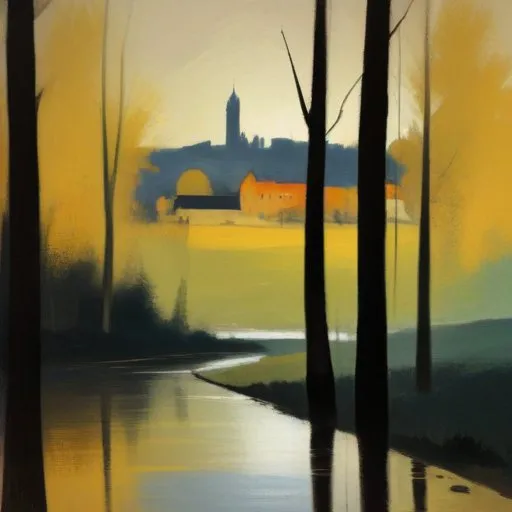
A Berlin-based Impressionist painter, capturing urban life and landscapes with vivid colors and expressive brushstrokes, leaving a lasting mark on German art history.
Lesser Ury, a German impressionist painter, and printmaker, is most renowned for his captivating nocturnal café scenes and rainy street landscapes that evoke a sense of mystery and intimacy. His unique style, characterized by the use of subdued tones and dazzling light effects, has earned him a prominent place in the history of German art.
Ury was born on November 7, 1861, in Birnbaum, Kingdom of Prussia (now Międzychód, Poland), to a baker father. After his father's death in 1872, his family relocated to Berlin, where he left school in 1878 to apprentice with a tradesman. A year later, he moved to Düsseldorf to study painting at the Kunstakademie.
Ury's artistic journey took him to Brussels, Paris, and Munich, where he was exposed to various art styles and influences. In 1889, he held his first exhibition, which received a hostile reception. However, Adolph Menzel's support led to Ury receiving a prize from the Akademie, recognizing his talent.
In 1893, Ury joined the Munich Secession, a group of progressive artists seeking to break away from traditional art forms. This association marked a significant milestone in his career, as it allowed him to experiment with new styles and techniques.
Ury's signature style is characterized by his use of impressionist techniques to capture the essence of urban landscapes, interior scenes, and Biblical subjects. His nocturnal café scenes, in particular, showcase his mastery of light and color, evoking a sense of warmth and intimacy.
His artistic repertoire also includes landscapes, urban landscapes, and interior scenes, often rendered in subdued tones. However, his impressionist approach allowed him to create vibrant and dazzling effects, particularly in his depictions of foliage against summer skies.
Despite his growing critical reputation, Ury's habit of creating multiple versions of his compositions, often inferior in quality, has tarnished his legacy. This practice, although lucrative, has led to confusion among art historians and enthusiasts, making it challenging to distinguish between his original works and the reproductions.
Ury's introverted nature and distrust of people led to him becoming increasingly reclusive in his later years. He passed away on October 18, 1931, in Berlin and is buried in the Jewish Cemetery in Berlin-Weissensee.
Lesser Ury's contributions to German art and impressionism are undeniable. His nocturnal café scenes have inspired generations of artists, and his impressionist style continues to influence contemporary art.
Today, Ury's paintings and pastels are highly sought after, and his legacy serves as a testament to the power of art to capture the human experience.
Born in 1847
A leading figure in German Impressionism, he's renowned for his vibrant, expressive portraits and landscapes that captured the essence of Berlin's urban life. His work continues to inspire artists and art enthusiasts alike.
Born in 1858
A German painter who blended Impressionism and Expressionism to create vibrant, emotive works that explored the human condition, often focusing on portraits and landscapes.
Born in 1863
A Norwegian painter who created iconic, emotionally charged works that explored the human experience, including the famous piece "The Scream".
Born in 1890
Austrian soldier and painter who captured the intensity of human emotion through bold, expressive portraits and landscapes, often exploring themes of death, sexuality, and the human condition.
Born in 1886
Austrian-Swiss artist who pioneered Expressionism through vibrant, emotive paintings and plays that explored the human condition. His works often featured distorted forms and bold colors.
Born in 1867
A pioneering Expressionist artist, known for vibrant, emotive paintings and prints that explored the human condition, often with a focus on spirituality and the natural world.
Born in 1880
A German soldier-turned-painter who pioneered Expressionism, capturing the emotional essence of animals and landscapes in vibrant, abstracted forms. His work continues to inspire artists and art lovers alike.
Born in 1887
A pioneering expressionist painter who captured the vibrant spirit of early 20th-century Europe through bold, colorful works that blended Fauvism and Cubism. His innovative style continues to inspire artists today.
