


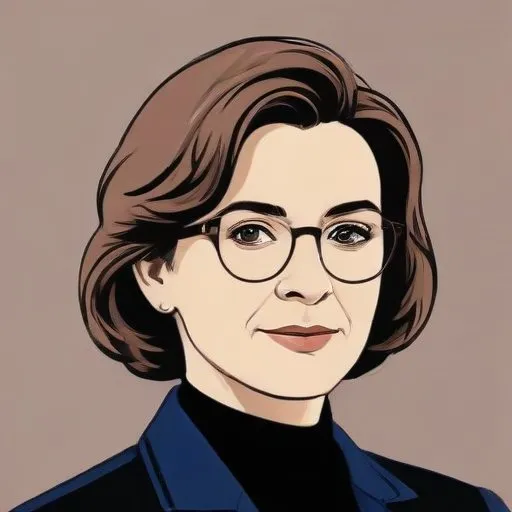
A pioneering French microbiologist who broke barriers for women in STEM, and a prolific writer and lecturer who shared her expertise with the world.
Liliane Ackermann, born on September 3, 1938, in Strasbourg, France, was a trailblazing microbiologist, writer, and lecturer who made significant contributions to the fields of microbiology and Jewish education.
Ackermann's family took refuge in Voiron, Isère during World War II, and it was not until 1956 that they returned to Strasbourg. She pursued her higher education at the Faculty of Sciences at the University of Louis Pasteur, Strasbourg, where she earned her first Ph.D. in microbiology in 1974. Later, in 1999, she obtained her second Ph.D. in Humanities from the University of Strasbourg.
Ackermann's illustrious career spanned over five decades, during which she taught at various levels, from elementary to university education. She was a dedicated educator who taught microbiology and biochemistry at the University of Louis Pasteur from 1976 to 1996. Additionally, she instructed adults in Jewish education and even taught Russian immigrants in Germany.
Ackermann's outstanding leadership and commitment to the Jewish community earned her a prominent place in the annals of Jewish history. Alongside her husband, Henri Ackermann, she took charge of the Youth Movement Yeshurun (Yechouroun) in 1972, a national religious group that organized year-round activities, winter and summer camps. Under their guidance, numerous Jewish leaders were nurtured, including prominent figures like René Gutman, Chief Rabbi of the Bas-Rhin, and Gilles Bernheim, Chief Rabbi of France from 2009 to 2013.
Ackermann's influence on modern Jewish society cannot be overstated. She played a pivotal role in shaping the values and principles of Jewish leaders, many of whom have gone on to occupy prominent positions in France and beyond. Her commitment to education, community service, and leadership has inspired generations of Jews, and her legacy continues to be felt in the realms of microbiology, education, and Jewish community development.
Ackermann's personal life was marked by significant milestones. She married Henri Ackermann, a dentist and community activist, in 1959, and together they had seven children: Théo, Jacqui, Anne, Raoul, Eric, Charles, and Marc. Her family was an integral part of her life, and she often worked in tandem with her husband to achieve their shared goals.
Although Ackermann did not leave behind a plethora of recorded quotes, her work and legacy speak volumes about her character and values. Her dedication to education, community service, and Jewish leadership has inspired countless individuals, and her influence continues to permeate the fabric of Jewish society.
Ackermann's life and work must be viewed within the broader context of Jewish history and the struggles faced by the Jewish community during World War II. Her courage, resilience, and determination in the face of adversity serve as a testament to the strength and fortitude of the Jewish people.
Ackermann's achievements can be compared to those of other pioneering women in the fields of microbiology and Jewish education. Her commitment to leadership, education, and community service sets her apart as a remarkable figure in the annals of Jewish history.
Ackermann's influence extends beyond the realms of microbiology and Jewish education, permeating the fabric of popular culture. Her commitment to community service, education, and leadership has inspired a new generation of leaders, thinkers, and change-makers.
Although Ackermann did not receive widespread public recognition for her work, her contributions to the fields of microbiology, Jewish education, and community leadership have earned her a revered place in the hearts and minds of those who knew her.
Ackermann's educational contributions have had a lasting impact on the Jewish community and beyond. Her dedication to teaching, leadership, and community service has inspired countless individuals, leaving behind a rich legacy that continues to shape the contours of Jewish education and society.
Ackermann's charitable work and social contributions were an integral part of her life and legacy. Her commitment to community service, education, and leadership has left an indelible mark on the Jewish community and beyond, serving as a testament to the power of altruism and social responsibility.
Ackermann's inspiring story serves as a beacon of hope, illuminating the path for future generations of leaders, thinkers, and change-makers.
Born in 1822
Developed vaccines for rabies and anthrax, and pioneered the germ theory of disease, revolutionizing our understanding of microbiology and disease prevention.
Born in 1843
A pioneering microbiologist and physician who discovered the bacteria that cause tuberculosis, cholera, and anthrax, revolutionizing the field of microbiology and saving countless lives.
Born in 1881
Discovered penicillin, a revolutionary antibiotic, and pioneered its use in medicine. This breakthrough has saved countless lives and transformed the field of healthcare.
Born in 1914
Developed the first inactivated poliovirus vaccine, leading to the near eradication of polio, and founded the Salk Institute for Biological Studies.
Born in 1749
Developed the smallpox vaccine, revolutionizing disease prevention and saving countless lives.
Born in 1845
Developed the theory of phagocytosis, which describes how cells engulf and destroy foreign particles and bacteria, leading to a deeper understanding of the immune system.
Born in 1821
A pioneer in modern medicine, he founded the field of social medicine, emphasizing the importance of social and environmental factors on health, and made significant contributions to cellular pathology.
Born in 1859
A pioneer in radioactivity research, discovering elements like polonium and radium, and pioneering radioactive isolation techniques. Their groundbreaking work paved the way for advancements in medicine, energy, and materials science.
