


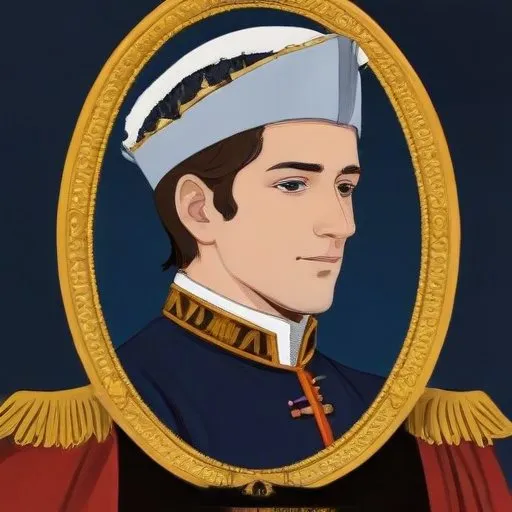
Heir apparent to the throne of France, known for being the son of King Louis XIV and father of King Philip V of Spain, playing a significant role in French and European history.
Louis, Grand Dauphin, was the eldest son and heir apparent of King Louis XIV of France and his spouse, Maria Theresa of Spain, born on November 1, 1661, at the Château de Fontainebleau. He was known as the Grand Dauphin after the birth of his own son, Louis, Duke of Burgundy, the Petit Dauphin, a title that would define his life as the heir to the throne who never quite reached the pinnacle of power.
As a Fils de France (Son of France), Louis was entitled to the style of Royal Highness. His baptism on March 24, 1662, at the chapel of the Château de Saint-Germain-en-Laye, was a grand affair, with the Cardinal de Vendôme and the Princess of Conti acting as proxies for the godparents, Pope Clement IX and Henrietta Maria of England. The occasion was even commemorated with a motet, Plaude Laetare Gallia, composed by Jean-Baptiste Lully.
Louis was initially under the care of royal governesses, including Julie d'Angennes and Louise de Prie de La Mothe-Houdancourt. At the age of seven, he was removed from the care of women and placed in a society of men, with Charles de Sainte-Maure as his governor. Jacques-Bénigne Bossuet, the Bishop of Meaux, was his tutor, tasked with shaping the young prince's mind. However, according to Philippe Erlanger, Louis XIV secretly harbored suspicions about his son's abilities, much like Louis XIII had once doubted his own son.
Louis, Grand Dauphin, lived his life in the shadow of his father, the Sun King, Louis XIV. He was never quite able to escape the imposing figure of his father, who dominated the French monarchy and European politics. Despite his privileged upbringing, Louis struggled to find his place in the royal court, often finding himself at odds with his father's expectations.
Louis, Grand Dauphin, married Marie Émilie de Joly de Choin, but the union was childless. However, he had a son, Louis, Duke of Burgundy, the Petit Dauphin, with his second wife, Marie Adelaide of Savoy. Despite never taking the throne himself, Louis's grandson would go on to become King Louis XV of France, while his second son inherited the Spanish throne as Philip V through his grandmother.
Louis, Grand Dauphin, died on April 14, 1711, before his father, ensuring that he would never reign as king. His life serves as a testament to the complexities of royal succession and the delicate balance of power within the French monarchy. Despite his own lack of achievement, Louis played a crucial role in shaping the future of the French throne, leaving behind a lasting legacy as the father of a future king.
Born in 1710
The monarch who ruled France from 1715 to 1774, known as the "Sun King's" great-grandson, and remembered for his extravagance, absolutism, and the decline of the French monarchy.
Born in 1641
A mastermind behind French military victories and reforms, credited with modernizing the French army and establishing the Palace of Versailles as a royal residence.
Born in 1619
A 17th-century mastermind who centralized France's economy, creating a powerful and efficient financial system that fueled the country's growth and prosperity. He's renowned for his innovative economic policies and reforms.
Born in 1601
The queen who ruled France alongside her son Louis XIV, known as the Sun King, and played a significant role in shaping the country's politics and culture during the 17th century. She was a skilled diplomat and strategist who helped to establish France as a dominant European power.
