


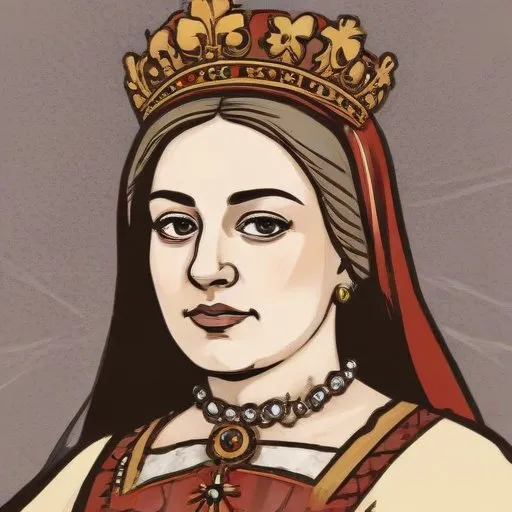
Wife of Emperor Charles VII, she played a significant role in shaping 18th-century European politics and culture through her diplomatic efforts and patronage of the arts.
Maria Amalia, Holy Roman Empress, was a renowned figure in 18th-century European politics, known for her role as the spouse of Emperor Charles VII and her impressive array of titles, including queen of Bohemia and electress of Bavaria. As the daughter of Emperor Joseph I, she wielded considerable influence in the intricate web of alliances and diplomatic intrigue that characterized the era.
Born on October 22, 1701, in the Hofburg Palace in Vienna, Maria Amalia was the youngest daughter of Emperor Joseph I and Wilhelmine Amalia of Brunswick-Lüneburg. Her early life was marked by a strict Catholic upbringing, which instilled in her a strong sense of duty and responsibility. Maria Amalia's personality was described as vivid and extroverted, differing from her elder sister, Maria Josepha, who was more reserved and introverted.
The death of her father in 1711 led to a significant shift in Maria Amalia's life trajectory. Her uncle, Charles VI, succeeded to the throne, and the Mutual Pact of Succession, signed by her father and uncle, gave precedence to her own claim to the throne over that of her cousins. However, Charles VI replaced this pact with the Pragmatic Sanction of 1713, which relegated Maria Amalia and her sister to secondary status in the order of succession.
To secure better relations between Savoy and Austria, Maria Amalia was proposed as a bride for Victor Amadeus, Prince of Piedmont, heir to the Kingdom of Sicily and the Duchy of Savoy. Although the plan ultimately failed, Maria Amalia's marriage to Emperor Charles VII in 1722 cemented her position as a key figure in European politics. Her union with Charles VII produced a son, Maximilian III Joseph, Elector of Bavaria, who would go on to play a significant role in Bavarian politics.
Maria Amalia's influence extended beyond her role as empress, as she played a crucial part in shaping the diplomatic landscape of 18th-century Europe. Her diplomatic prowess helped maintain the delicate balance of power between European nations, earning her the respect of her contemporaries. Maria Amalia's legacy as a skilled diplomat and stateswoman has endured, with many regarding her as one of the most influential women of her time.
Maria Amalia's remarkable life serves as a testament to her strength, intelligence, and unwavering commitment to her duties as empress. Her lasting impact on European politics and her role as a trailblazer for women in diplomacy continue to inspire and fascinate historians and scholars to this day.
Born in 1768
The last Holy Roman Emperor, who ruled from 1792 to 1806, oversaw the dissolution of the Holy Roman Empire and was a key figure in European politics during the Napoleonic Wars.
Born in 1717
The wife of Francis I, Holy Roman Emperor, ruled Austria and its territories with intelligence and diplomacy, implementing reforms and expanding the empire through strategic marriages. She's remembered for her strong leadership and cultural achievements.
Born in 1741
Reformer of the Habsburg dominions, abolishing serfdom and promoting religious tolerance, who implemented numerous reforms to modernize his empire.
Born in 1747
The last Habsburg ruler to hold the title of Holy Roman Emperor, he oversaw the dissolution of the empire and played a key role in European politics during the French Revolution.
Born in 1768
The last Holy Roman Emperor, who ruled from 1792 to 1806, oversaw the dissolution of the Holy Roman Empire and was a key figure in European politics during the Napoleonic Wars.
Born in 1769
A French military leader who rose to prominence during the French Revolution and became Emperor of France, known for his military conquests and reorganization of Europe. He is also famous for his Napoleonic Code, which remains a foundation of modern law.
Born in 1755
The last queen of France before the French Revolution, known for her extravagance and mismanagement of the French economy, which contributed to the downfall of the monarchy.
Born in 1710
The monarch who ruled France from 1715 to 1774, known as the "Sun King's" great-grandson, and remembered for his extravagance, absolutism, and the decline of the French monarchy.
