


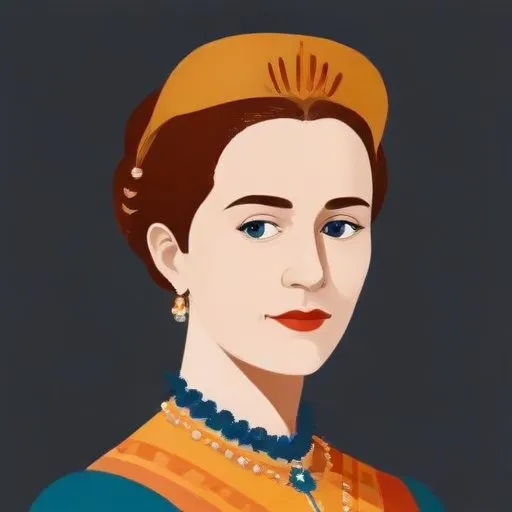
Daughter of Emperor Francis I and Empress Maria Theresa, she was a Habsburg archduchess and the last Dauphine of France before the French Revolution. She was known for her strong will and attempts to reform the French monarchy.
Maria Josepha of Austria, born on December 8, 1699, was a royal figure who left an indelible mark on the history of Poland and Saxony. As the Queen of Poland and Electress of Saxony, she played a significant role in shaping the fate of these territories, albeit often eclipsed by her more prominent relatives.
Maria Josepha was born in Vienna as the eldest child of Joseph I, Holy Roman Emperor, and Princess Wilhelmina Amalia of Brunswick-Lüneburg. She was named after her father and held a prominent position in the Habsburg monarchy from a young age. Her sister, Maria Amalia, would later become Electress of Bavaria.
A marriage between Maria Josepha and Frederick Augustus II, Elector of Saxony, had been proposed since 1704. However, the fact that Maria Josepha was not allowed to marry a non-Catholic hindered the union. It wasn't until Augustus converted to Catholicism in 1712 that the negotiations became serious. Emperor Charles VI eventually forbade Maria Josepha and her sister from marrying until they renounced their positions in the line of succession, securing the succession for Charles's future daughter Maria Theresa.
Maria Josepha renounced her claim on August 10, 1719. Ten days later, she married Frederick Augustus II, cementing the alliance between the Houses of Wettin and Habsburg. This union aimed to strengthen Saxony's position in the event of a war of succession to the Austrian territories.
Through her marriage, Maria Josepha played a crucial role in shaping the fate of Poland and Saxony. Her eldest surviving son, Frederick Christian, eventually succeeded his father as Elector of Saxony. Although often overshadowed by her more prominent relatives, Maria Josepha's legacy lies in her ability to navigate complex political alliances and secure a lasting impact on the territories she ruled.
Maria Josepha's life was marked by the complexities of royal politics and the shifting alliances between European powers. Despite being relegated to the shadows of her more prominent relatives, her legacy as Queen of Poland and Electress of Saxony remains an important chapter in the history of these territories.
Maria Josepha's life and reign can be compared to that of her sister, Maria Amalia, who became Electress of Bavaria. While both women navigated complex royal politics, Maria Josepha's marriage to Frederick Augustus II and her role as Queen of Poland and Electress of Saxony set her apart from her sister's experiences.
Born in 1755
The last queen of France before the French Revolution, known for her extravagance and mismanagement of the French economy, which contributed to the downfall of the monarchy.
Born in 1710
The monarch who ruled France from 1715 to 1774, known as the "Sun King's" great-grandson, and remembered for his extravagance, absolutism, and the decline of the French monarchy.
Born in 1741
Reformer of the Habsburg dominions, abolishing serfdom and promoting religious tolerance, who implemented numerous reforms to modernize his empire.
Born in 1797
Ruler of Tuscany from 1824 to 1859, known for his liberal reforms and modernization of the region. He also played a key role in the unification of Italy.
Born in 1768
The last Holy Roman Emperor, who ruled from 1792 to 1806, oversaw the dissolution of the Holy Roman Empire and was a key figure in European politics during the Napoleonic Wars.
Born in 1793
Emperor of Austria from 1835 to 1848, known for his role in the Revolutions of 1848 and his abdication in favor of his nephew Franz Joseph.
Born in 1338
The King of France from 1364 to 1380, known for his military victories and rebuilding of Paris, earning him the nickname "Charles the Wise".
Born in 1710
The monarch who ruled France from 1715 to 1774, known as the "Sun King's" great-grandson, and remembered for his extravagance, absolutism, and the decline of the French monarchy.
