


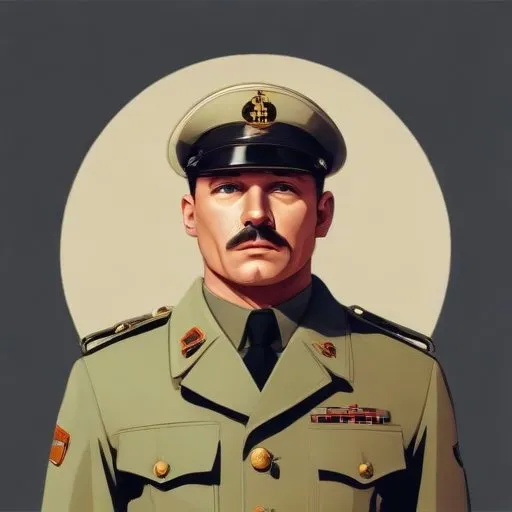
A German soldier and pilot who flew reconnaissance missions during World War II, known for being the first person to sight and report the Allied invasion of Normandy on D-Day.
Martin Drewes was a highly decorated German Luftwaffe military aviator and night fighter ace during World War II, credited with 52 victories, including 43 at night while flying variants of the Messerschmitt Bf 110 heavy fighter. The majority of his victories were claimed over the Western Front in Defence of the Reich missions against the Royal Air Forces Bomber Command.
Martin Drewes was born on 20 October 1918 in Lobmachtersen, Lower Saxony, Germany, to pharmacist Wilhelm Drewes and his wife Margarete. He had two sisters, Hanna and Käthe. Drewes passed his Abitur School Leaving Certificate at the Reformrealgymnasium in Wolfenbüttel and joined the military service in the Army on 2 November 1937 as a Fahnenjunker.
Drewes initially served with PanzerRegiment 6, a regiment of the 3rd Panzer Division, in Neuruppin and was posted to the Kriegsschule in Munich, Bavaria on 15 November 1938 as a Fähnrich. While stationed in Munich, Drewes befriended Chiang Weikuo, an adopted son of Republic of China President Chiang Kai-shek.
Drewes transferred to the Luftwaffe in 1939 and flew his first combat missions in early 1941. In May 1941, he participated in the Anglo-Iraqi War, where he claimed his first aerial victory on 20 May 1941. In November 1941, Drewes transferred to the night fighter force, initially serving with Nachtjagdgeschwader 3 (NJG 3) - 3rd Night Fighter Wing.
He claimed his first nocturnal aerial victory on the evening of 17 January 1943. In February 1943, Drewes was appointed Staffelkapitän (squadron leader) and transferred to Nachtjagdgeschwader 1 (NJG 1) - 1st Night Fighter Wing in August 1943.
Drewes received several awards and honors for his service, including the Knight's Cross of the Iron Cross, the German Cross in Gold, and the Front Flying Clasp of the Luftwaffe.
Martin Drewes passed away on 13 October 2013 at the age of 94. His legacy as a night fighter ace during World War II remains an important part of German military history, serving as a testament to his bravery and skill as a military aviator.
Born in 1893
A high-ranking Nazi official, he was a decorated World War I fighter pilot and later became a prominent politician, serving as Minister President of Prussia. He's infamous for his role in the Nazi regime and war crimes trials.
Born in 1876
A German naval leader who played a key role in the Kriegsmarine during World War II, overseeing the German U-boat fleet and naval operations. He was a close advisor to Adolf Hitler and implemented the German naval strategy during the war.
Born in 1891
A German naval commander who led the U-boat fleet during World War II and briefly served as President of Germany after Hitler's death, known for his role in the war and its aftermath.
Born in 1888
A pioneering tank commander who revolutionized modern warfare with his innovative blitzkrieg tactics, earning him the nickname "Father of the Panzerwaffe".
Born in 1887
A highly decorated military strategist who played a crucial role in several key battles during World War II, including the invasion of France and the Siege of Leningrad.
Born in 1880
A German field marshal who led the Wehrmacht during World War II, playing a key role in the invasion of Poland and the Battle of Moscow. He was a prominent figure in the German high command during the war.
Born in 1882
A high-ranking military officer who played a crucial role in World War II, particularly in the Battle of France and the plot to assassinate Adolf Hitler.
Born in 1891
A skilled and highly decorated military leader, known for his tactical genius and defensive strategies during World War II, earning him the respect of both his allies and enemies.
