


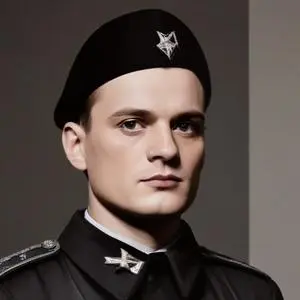
A highly decorated tank commander during World War II, known for his exceptional combat skills and record-breaking number of enemy tanks destroyed. He is often referred to as the greatest tank ace of all time.
Michael Wittmann is best known for his extraordinary feat of destroying up to 14 tanks, 15 personnel carriers, and two anti-tank guns within a mere 15 minutes during the Battle of Villers-Bocage on June 13, 1944. This remarkable achievement cemented his legacy as one of the most skilled and feared tank commanders of World War II.
Wittmann was born on April 22, 1914, in the village of Vogelthal, near Dietfurt in Bavaria's Upper Palatinate region. He enlisted in the German Army in 1934 and later joined the Schutzstaffel (SS) in October 1936, where he was assigned to the Leibstandarte SS Adolf Hitler (LSSAH) regiment.
In 1941, Wittmann's unit was transferred to the Eastern Front, where he participated in Operation Barbarossa, the invasion of the Soviet Union. He quickly rose through the ranks, becoming a platoon leader in the heavy company.
Wittmann's exceptional skills as a tank commander earned him numerous accolades, including the Oak Leaves to the Knight's Cross of the Iron Cross, which he received from Adolf Hitler himself on February 2, 1944. At the time, he was credited with 117 tank kills, a staggering achievement that solidified his reputation as a panzer ace.
Throughout his career, Wittmann commanded various tanks, including the StuG III assault gun-tank destroyer, the Panzer III medium tank, and the formidable Tiger I tank. His exceptional tactical prowess and bravery under fire earned him widespread recognition within the German military.
After the war, Wittmann's legend grew, and he became a cult figure, romanticized in popular culture as a symbol of German military prowess. However, historians have debated the extent of his achievements, with some criticizing his tactical performance and questioning the accuracy of his tank kill count.
Despite the controversy, Wittmann remains an integral part of World War II history, with some estimating his total tank kills to be as high as 135-138. His feats on the battlefield continue to inspire and fascinate, serving as a testament to the bravery and skill of tank commanders during wartime.
Wittmann's personal life remains somewhat of an enigma, with little information available about his family and relationships. Tragically, Wittmann's life was cut short on August 8, 1944, when he was killed in action during the Battle of Falaise Pocket in Normandy, France.
Michael Wittmann's remarkable story serves as a reminder of the bravery and skill displayed by tank commanders during World War II. Despite the controversy surrounding his achievements, his legacy continues to captivate and inspire, cementing his place as one of the most iconic figures of the war.
Born in 1891
A renowned World War II military strategist, known for leading the Afrika Korps and earning the respect of both allies and enemies with his tactical genius.
Born in 1888
A pioneering tank commander who revolutionized modern warfare with his innovative blitzkrieg tactics, earning him the nickname "Father of the Panzerwaffe".
Born in 1915
A notorious Waffen-SS commander, infamous for his role in the Malmedy massacre during the Battle of the Bulge, and other war crimes.
Born in 1896
A high-ranking Waffen-SS officer who played a crucial role in several key battles on the Eastern Front during World War II, known for his military prowess and tactical genius.
Born in 1893
A highly decorated World War II tank commander, known for his tactical genius and innovative armored warfare strategies. He played a key role in several major battles, including the Battle of Stalingrad.
Born in 1892
A ruthless and efficient administrator who oversaw the creation and operation of Nazi concentration camps during World War II, responsible for the deaths of millions of people.
