


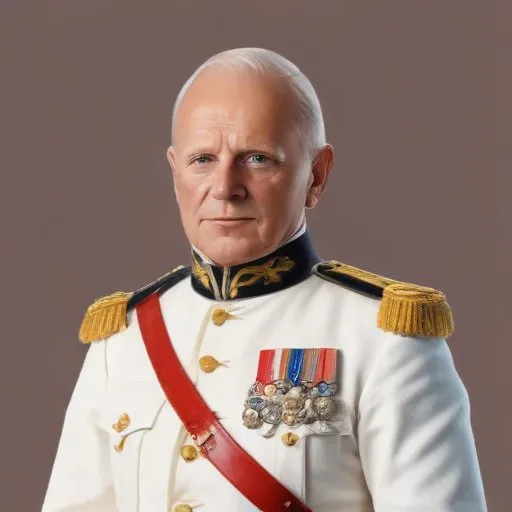
Austrian field marshal who played a key role in the Napoleonic Wars, leading troops to several victories against French forces. He's also known for his cultural patronage, supporting famous composers like Haydn and Mozart.
Known for his exceptional patronage of the arts, particularly music, and his illustrious military career, Prince Paul II Anton Esterhzy was a true Renaissance man of 18th-century Europe. As a member of the esteemed Esterhzy family, he continued the family's tradition of supporting the Habsburg monarchy, while also leaving an indelible mark on the world of classical music.
Born on April 22, 1711, in Eisenstadt, Archduchy of Austria, Paul Anton was the son of Prince Joseph Anton Esterhzy de Galntha and Baroness Maria Octavia von Gilleis zu Theras und Sonnenberg. He was part of a large family, with three siblings, including a younger brother, Nikolaus Joseph, and two sisters, Maria Josepha and Anne Maria. Paul Anton received his education in Vienna and Leiden, where he developed a deep appreciation for culture, a trait that would later define his life's work.
In 1733, Prince Paul Anton became a freemason, an affiliation that would have a profound impact on his life and career. This marked the beginning of his association with the world of music, which would become an integral part of his legacy. As a patron of the arts, he supported numerous composers, including Haydn, who would later become his Kapellmeister (music director) at the Esterhzy court.
Paul Anton's military career was marked by distinction and bravery. He led a regiment of hussars during the War of the Austrian Succession (1741-1748) and was appointed Fieldmarshal-Lieutenant in 1747. His military prowess earned him the respect of Empress Maria Theresa of Austria, who sent him as imperial envoy to Naples, where he served from 1750 to 1753. During the Seven Years' War, he fought as a General of the Cavalry and was promoted to Field Marshal in 1758.
Prince Paul II Anton Esterhzy's legacy extends far beyond his military accomplishments. As a patron of the arts, he played a significant role in fostering the development of classical music. His association with Haydn and other prominent composers of the time helped shape the music landscape of the 18th century. Moreover, his support for the Habsburg monarchy contributed to the empire's stability and prosperity during a tumultuous period in European history.
Despite his many accomplishments, Prince Paul II Anton Esterhzy's personal life was marked by a sense of duty and responsibility. He was a devoted son, brother, and uncle, and his family played an essential role in his life. He was also a philanthropist, supporting various charitable causes throughout his life, particularly in the fields of education and healthcare.
Prince Paul II Anton Esterhzy's life and achievements must be viewed within the context of 18th-century Europe, a time of great change and upheaval. His commitment to the arts, his military service, and his philanthropy have left an indelible mark on history. He remains an inspiration to anyone who values the importance of culture, education, and service to humanity.
In conclusion, Prince Paul II Anton Esterhzy was a true luminary of his time, whose contributions to the worlds of music, military, and philanthropy continue to inspire and enrich our lives today.
Born in 1747
The last Habsburg ruler to hold the title of Holy Roman Emperor, he oversaw the dissolution of the empire and played a key role in European politics during the French Revolution.
Born in 1768
The last Holy Roman Emperor, who ruled from 1792 to 1806, oversaw the dissolution of the Holy Roman Empire and was a key figure in European politics during the Napoleonic Wars.
Born in 1717
The wife of Francis I, Holy Roman Emperor, ruled Austria and its territories with intelligence and diplomacy, implementing reforms and expanding the empire through strategic marriages. She's remembered for her strong leadership and cultural achievements.
Born in 1741
Reformer of the Habsburg dominions, abolishing serfdom and promoting religious tolerance, who implemented numerous reforms to modernize his empire.
Born in 1747
The last Habsburg ruler to hold the title of Holy Roman Emperor, he oversaw the dissolution of the empire and played a key role in European politics during the French Revolution.
Born in 1768
The last Holy Roman Emperor, who ruled from 1792 to 1806, oversaw the dissolution of the Holy Roman Empire and was a key figure in European politics during the Napoleonic Wars.
Born in 1793
Emperor of Austria from 1835 to 1848, known for his role in the Revolutions of 1848 and his abdication in favor of his nephew Franz Joseph.
Born in 1500
Ruling over a vast empire from 1519 to 1556, he was a powerful and influential leader who played a crucial role in shaping European politics and religion. He is most known for his efforts to unify Christian Europe and defend it against the Ottoman Empire.
