


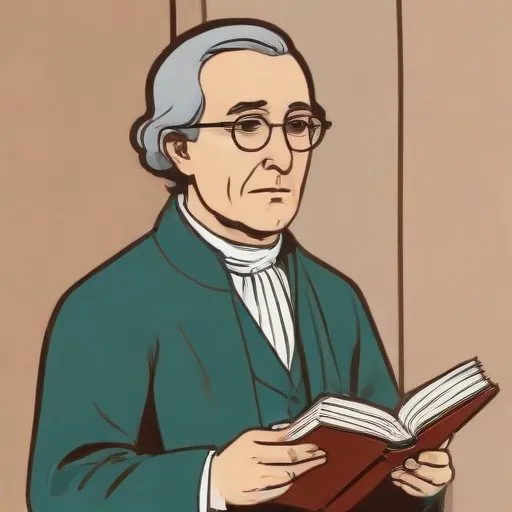
A prominent 18th-century hymn-writer and educator, known for his influential hymns and contributions to the development of Christian education. His works remain popular in Protestant churches to this day.
Philip Doddridge, a prominent English Nonconformist minister, educator, and hymnwriter, left an indelible mark on the world of Christianity with his soul-stirring hymns and dedication to education. He is best known for his contributions to the Congregationalist movement and his efforts to promote religious tolerance and understanding.
Born on June 26, 1702, in London, Philip Doddridge was the last of twenty children to Daniel Doddridge, a dealer in oils and pickles, and Elizabeth, a devout woman who played a significant role in shaping his early life. His mother, who taught him the history of the Old and New Testament from a young age, instilled in him a deep love for scripture and spirituality.
Following his parents' deaths, Philip was placed under the care of a guardian, Downes, who enrolled him in a private school in St Albans. It was here that he came under the influence of the Presbyterian minister Samuel Clarke, who took him under his wing and provided him with the support and guidance he needed.
Philip Doddridge's ministerial career spanned over three decades, during which he became a prominent figure in the Nonconformist movement. He served as a minister in various churches, including the Congregational church in Northampton, where he spent the majority of his career.
He was a prolific writer and published numerous works, including sermons, treatises, and hymns. His most famous work, The Rise and Progress of Religion in the Soul, a comprehensive guide to Christian living, remains a classic in Christian literature.
Philip Doddridge's hymns, characterized by their simplicity, beauty, and emotional depth, have been a source of inspiration and comfort to countless Christians. His collection of hymns, The Psalms of David, Imitated in the Language of the New Testament, contains some of his most famous works, including "O God of Bethel, by Whose Hand" and "Hark! The Glad Sound! The Savior Comes."
Philip Doddridge's legacy extends beyond his contributions to the Nonconformist movement. His commitment to education and religious tolerance paved the way for greater understanding and cooperation between different Christian denominations.
His emphasis on the importance of personal faith and devotion has inspired generations of Christians, and his hymns continue to be sung in churches around the world.
Philip Doddridge's life and work serve as a testament to the power of faith, perseverance, and dedication. His contributions to the world of Christianity continue to inspire and nourish the hearts of believers around the world.
Through his hymns, sermons, and writings, Philip Doddridge has left an enduring legacy that transcends time and denominational boundaries, reminding us of the transformative power of faith and the importance of living a life of devotion and service to others.
Born in 1674
A renowned hymnwriter and theologian who penned over 750 hymns, including "Joy to the World" and "When I Survey the Wondrous Cross", shaping Christian worship and literature.
Born in 1891
A pioneering historian and author who shed light on African American history and culture through his extensive research and writings. His works helped to preserve and promote the contributions of African Americans to the country's development.
Born in 1703
A prominent figure in the 18th-century Methodist movement, he founded the Methodist Church and emphasized personal faith, social justice, and education. His teachings and legacy continue to shape Protestantism today.
Born in 1714
A charismatic Anglican priest who led a spiritual revival in 18th-century England and America, preaching to massive crowds and influencing the development of evangelical Christianity.
Born in 1731
A renowned poet and hymnwriter, known for his evocative and expressive works that explored themes of nature, faith, and the human experience. His hymns, such as "Light Shining Out of Darkness", remain popular to this day.
Born in 1725
A former slave trader who later became a prominent abolitionist and wrote the iconic hymn "Amazing Grace". He's a symbol of redemption and a powerful voice against slavery.
Born in 1740
A prominent cleric and hymn writer, he penned the iconic hymn "Rock of Ages" and advocated for Calvinist theology. His works remain influential in Christian worship and literature.
