


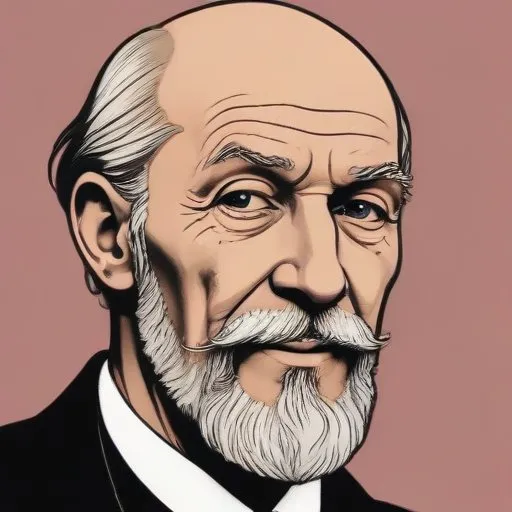
Wrote influential self-help books, including "Self-Help" and "Thrifty", that promoted personal responsibility and individualism.
Samuel Smiles is best known for his influential work, Self-Help, published in 1859, which promoted the ideas of thrift, responsible habits, and attacked materialism and laissez-faire government. This seminal book has been hailed as the "bible of mid-Victorian liberalism" and has had lasting effects on British political thought.
Smiles was born on December 23, 1812, in Haddington, East Lothian, Scotland, to Janet Wilson of Dalkeith and Samuel Smiles of Haddington. He was one of eleven surviving children, and his family members were strict Reformed Presbyterians, although he did not practice the faith.
Smiles studied at a local school until the age of 14, after which he apprenticed to be a doctor under Dr. Robert Lewins. This arrangement enabled him to study medicine at the University of Edinburgh in 1829, where he furthered his interest in politics and became a strong supporter of Joseph Hume.
In 1837, Smiles wrote articles for the Edinburgh Weekly Chronicle and the Leeds Times, campaigning for parliamentary reform. In November 1838, he was invited to become the editor of the Leeds Times, a position he accepted and held for twenty years.
During his tenure as editor, Smiles moved to live on Woodhouse Cliff in 1847 and continued to promote his ideas of self-improvement and social reform through his writings.
Smiles' philosophy was centered around the idea that individuals could improve their circumstances through hard work, thrift, and responsible habits. He believed that poverty was largely caused by irresponsible habits and that materialism and laissez-faire government were hindrances to progress.
Through his work, Smiles aimed to promote a sense of self-reliance and individual responsibility, encouraging people to take control of their own lives and destinies.
Smiles' ideas have had a lasting impact on British political thought, influencing the development of liberal politics and social reform. His emphasis on self-help and individual responsibility has inspired generations of thinkers and politicians.
In addition, Smiles' work has influenced the development of social welfare policies, with his ideas on thrift and responsible habits shaping the way governments approach poverty and social inequality.
In 1832, Smiles' father died in the cholera epidemic, but his mother's determination to support herself and his nine younger siblings influenced Smiles' future life and outlook.
Smiles' relationship with his mother had a profound impact on his life, shaping his views on hard work, self-reliance, and the importance of individual responsibility.
Samuel Smiles' work has left an indelible mark on British history, shaping the course of social reform and liberal politics. His emphasis on self-help and individual responsibility continues to inspire and influence thinkers and politicians to this day.
Through his writings and teachings, Smiles has inspired generations to take control of their own lives, promoting a sense of self-reliance and individual responsibility that continues to shape modern society.
Born in 1812
A renowned author of timeless classics, crafting vivid stories that exposed social injustices and explored the human condition, leaving an indelible mark on literature.
Born in 1795
A 19th-century historian, philosopher, and academic who wrote influential works on history, politics, and society, particularly "The French Revolution" and "On Heroes, Hero-Worship, and The Heroic in History".
Born in 1806
A prominent 19th-century thinker who championed individual liberty, free speech, and women's rights, and is best known for his influential book "On Liberty".
Born in 1820
A pioneering thinker who coined the phrase "survival of the fittest" and applied evolutionary principles to social sciences, shaping modern sociology and philosophy.
Born in 1819
A prominent art critic and social reformer who championed the Pre-Raphaelite movement and advocated for social justice, leaving a lasting impact on art, architecture, and literature.
Born in 1822
A prominent Victorian-era poet and cultural critic, known for his influential essays on literature and society, which helped shape the modern concept of culture and its role in society.
Born in 1825
A prominent figure in the scientific community, known for advocating Charles Darwin's theory of evolution and coining the term "agnostic" to describe his own religious views.
Born in 1809
Developed the theory of evolution through natural selection, revolutionizing our understanding of life on Earth. This groundbreaking idea transformed the fields of biology, ecology, and beyond.
