


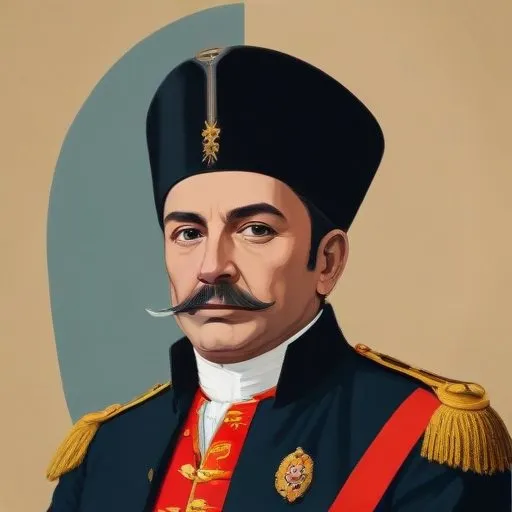
Santiago de Liniers y Bremond, 1st Count of Buenos Aires, is remembered as the hero who led the reconquest of Buenos Aires after the first British invasion of the River Plate in 1806. This Spanish military officer and viceroy of the Viceroyalty of the Rio de la Plata earned his place in history by defending the settlement against not one, but two British invasions and a mutiny that sought to replace him.
Born on July 25, 1753, in Niort, Poitou, France, as Jacques de Liniers, he was the 4th son of Jacques Joseph Louis, comte de Liniers, and Henriette Thérese de Brémond d'Ars. The Liniers family had been part of the French nobility since the 11th century, with one of their ancestors, Guillaume de Liniers, killed at the Battle of Poitiers during the Hundred Years War.
At the age of 12, Liniers entered the military academy of the Order of St. John, where he trained for a military career. He went on to become a Captain in the Spanish Royal Navy and a Chevalier of the Order of Saint John, as well as a Caballero of the Order of Montesa.
In 1806, Liniers led the reconquest of Buenos Aires after the first British invasion of the River Plate. His success earned him the appointment as viceroy, replacing Rafael de Sobremonte, a move that was unprecedented without the King's direct intervention. However, he was confirmed in office by Charles IV of Spain.
Liniers successfully defended the settlement against a second British invasion in 1807, solidifying his reputation as a military leader. He also put down a mutiny that sought to replace him, further demonstrating his ability to maintain order and stability.
In 1809, Liniers was replaced as viceroy by Baltasar Hidalgo de Cisneros, appointed by the Junta of Seville. He retired from public life, but when the May Revolution took place, Liniers decided to come out of retirement and organized a monarchist uprising in Córdoba. He was eventually captured and executed without trial in 1810.
Despite his tragic end, Liniers is remembered as a hero and a true patriot. His bravery and military prowess earned him the respect and admiration of his people, and his legacy continues to inspire generations to come.
In conclusion, Santiago de Liniers y Bremond, 1st Count of Buenos Aires, was a true hero of his time, whose bravery and military prowess will be remembered for generations to come.
Born in 1770
A key figure in Argentina's struggle for independence, he created the country's flag and played a crucial role in its early development.
Born in 1778
Led the successful fight for independence in Argentina, Chile, and Peru, and is revered as a national hero in these countries. He's also credited with creating the Army of the Andes, a crucial force in the Latin American wars of independence.
Born in 1783
Led the Latin American wars of independence against Spanish rule, unifying several countries under the Gran Colombia republic. He's revered as a national hero and symbol of freedom.
Born in 1795
Led the Latin American wars of independence against Spain, and later became the president of Bolivia, playing a key role in the country's early development. He's revered as a national hero in Bolivia and Venezuela.
Born in 1764
Led the Uruguayan struggle for independence from Spain and is considered the father of Uruguayan nationhood, known for his military victories and democratic ideals.
Born in 1778
Led Chile's struggle for independence from Spain, becoming a national hero and symbol of freedom. He's revered for his bravery, strategic thinking, and vision for a unified Chile.
Born in 1754
Led the Patricios Regiment, a key military unit in the Argentine War of Independence, and played a crucial role in the country's struggle for freedom from Spanish rule.
