


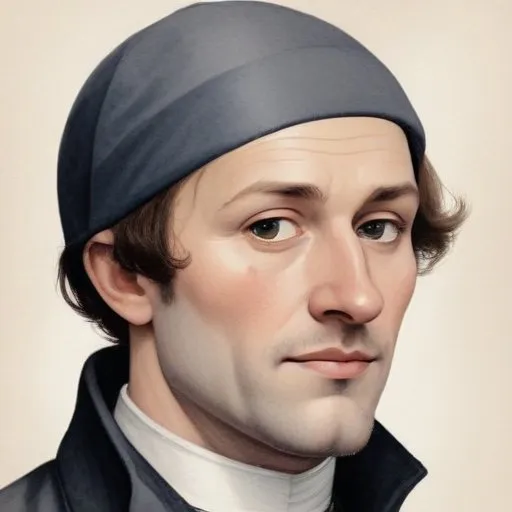
A German Renaissance humanist and theologian who wrote influential works on biblical interpretation and church reform, shaping Protestant thought in the 16th century.
Sebastian Franck, a 16th-century German freethinker, humanist, and radical reformer, is renowned for his unyielding commitment to creating a universal, invisible spiritual church, transcending the boundaries of traditional Christian sects. Through his writings and teachings, Franck aimed to bridge the gaps between Lutheranism, Zwinglianism, and Anabaptism, propelling the Protestant Reformation forward.
Franck was born on January 20, 1499, in Donauwörth, Swabia, and later styled himself Franck von Wört. He embarked on his academic journey at the University of Ingolstadt in 1515, followed by a stint at Bethlehem College, where he crossed paths with influential figures like Martin Bucer and Martin Frecht.
Initially ordained as a priest, Franck's theological beliefs underwent a significant shift in 1525, causing him to join the Reformed party in Nuremberg. He became the preacher at Gustenfelden and authored a German translation of Andrew Althamer's Diallage, a treatise aimed at countering Sacramentarianism and Anabaptism.
Franck's prolific writing career continued with Supplycacyon of the Beggers, a free adaptation of Simon Fish's English Protestant work. This publication exemplified Franck's growing dissent from traditional Protestantism, foreshadowing his eventual disillusionment with Lutheranism, Zwinglianism, and Anabaptism.
In 1530, Franck translated a Latin chronicle on the Ottoman Empire, prefaced by Martin Luther. He appended a visionary passage, exhorting Christians to emulate the virtues of the Turkish empire. This audacious move solidified Franck's stance on the need for a unified, spiritual church, untethered from the constraints of denominational divisions.
In 1528, Franck married Ottilie Beham, allegedly the sister of the renowned painters Bartholomew and Sebald Beham, who were disciples of Albrecht Dürer and Hans Denck. This union underscores Franck's connection to the artistic and intellectual circles of his time.
Franck's unrelenting pursuit of a universal spiritual church has left a profound impact on modern society. His legacy serves as a testament to the power of radical thinking and the importance of challenging established norms. As a result, Franck remains an enigmatic figure, celebrated for his unwavering commitment to creating a more inclusive, harmonious Christian community.
Franck's remarkable life and works continue to inspire scholars, theologians, and historians, cementing his place as a luminary of the Protestant Reformation.
Born in 1483
A German monk and priest who sparked the Protestant Reformation, challenging Catholic Church authority and shaping Western Christianity. He's famous for nailing 95 theses to a church door, sparking a religious revolution.
Born in 1497
A 16th-century Renaissance scholar who made significant contributions to the development of the Protestant Reformation and education, known for his theological writings and astronomical observations.
Born in 1509
A French pastor and theologian who played a key role in the Protestant Reformation, shaping Christian theology and influencing Western civilization. He's famous for his teachings on predestination and his role in establishing Calvinism.
Born in 1484
Leader of the Swiss Reformation, advocating for church reform and inspiring other Protestant movements.
Born in 1466
A 16th-century Renaissance humanist who advocated for education, tolerance, and critical thinking, and is famous for his witty and insightful writings, particularly "In Praise of Folly".
Born in 1489
Leader of the English Reformation, instrumental in creating the Church of England and authoring the Book of Common Prayer.
Born in 1504
A prominent figure in the Swiss Reformation, he played a key role in shaping Protestant theology and wrote influential works on covenant theology. His writings had a lasting impact on Reformed Christianity.
