


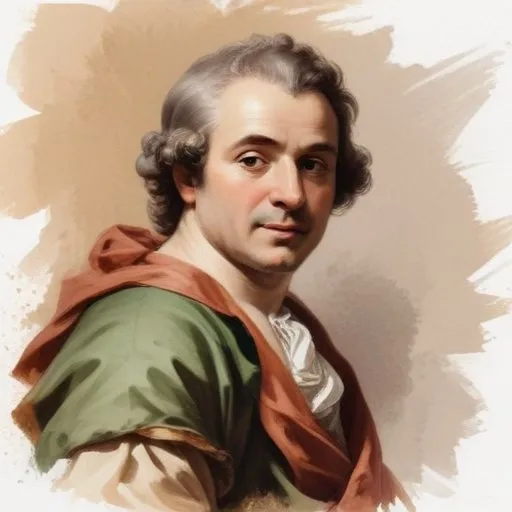
A prominent painter of the late Baroque period, known for his vivid and emotive works that blended classical and contemporary styles. His frescoes and altarpieces adorn many Italian churches and palaces.
Sebastiano Ricci was a 17th-century Italian painter renowned for his grand manner fresco paintings, characterized by vigorous and luminous strokes, which epitomized the late Baroque school of Venice. His works, often compared to those of his contemporaries, Piazzetta and Tiepolo, showcased his mastery of grandiose and dramatic compositions.
Born on August 1, 1659, in Belluno, Italy, Ricci's life was marked by controversy from an early age. In 1678, at just 19, he was imprisoned for attempting to poison a young woman to avoid marriage, after an unintended pregnancy. The intervention of a nobleman, likely a Pisani family member, secured his release. This tumultuous episode did not deter Ricci from pursuing his artistic passion.
Ricci's artistic talent was nurtured under the guidance of Federico Cervelli in Venice, where he was apprenticed in 1671. Some art historians suggest that Sebastiano Mazzoni might have been his first master. During his time in Bologna, Ricci's style was influenced by Giovanni Gioseffo dal Sole, which is evident in his later works.
Ricci's personal life was marked by turmoil, including his abandonment of his wife and daughter in 1688. He fled to Turin with Magdalen, the daughter of painter Giovanni Pellegrino, only to return to Venice later in his life.
Sebastiano Ricci's contributions to the late Baroque era are undeniable. His innovative use of color, light, and composition has inspired generations of artists. As the uncle of Marco Ricci, an innovator in landscape painting, Sebastiano Ricci's artistic legacy extends beyond his own works, shaping the development of Italian art in the 18th century.
Ricci's notable works include:
Ricci's artistic career spanned over four decades, leaving behind a rich legacy of artistic innovation and controversy.
Sebastiano Ricci's tumultuous life, marked by controversy and artistic brilliance, has left an indelible mark on the late Baroque era. His grand manner fresco paintings continue to inspire and awe art enthusiasts, solidifying his position as one of the greatest Italian painters of the 17th century.
Born in 1696
A renowned 18th-century painter of grand, sweeping scenes, celebrated for his vivid use of color and dramatic flair in frescoes and altarpieces.
Born in 1642
A 17th-century Jesuit Brother who excelled as an architect and painter, creating stunning Baroque trompe l'oeil ceilings that seemed to defy gravity. His works continue to inspire artists and architects today.
Born in 1634
A prolific Neapolitan painter and illustrator, renowned for his vibrant and emotive works that blended Baroque and Rococo styles, creating dramatic and expressive scenes.
Born in 1657
A prominent Neapolitan painter and illustrator of the Baroque era, known for his dramatic and emotive works, often depicting mythological and biblical scenes. His style blended grandeur and elegance, influencing 18th-century art.
Born in 1683
A prominent 18th-century painter of dramatic and emotionally charged scenes, known for his bold use of chiaroscuro and innovative composition.
Born in 1596
A prominent Baroque painter who created elaborate, dramatic, and emotive works that adorned the ceilings of Roman palaces and churches, influencing the development of 17th-century art.
Born in 1581
A prominent painter of the Baroque period, known for his vivid and emotive depictions of mythological and biblical scenes, which greatly influenced the development of 17th-century art.
