


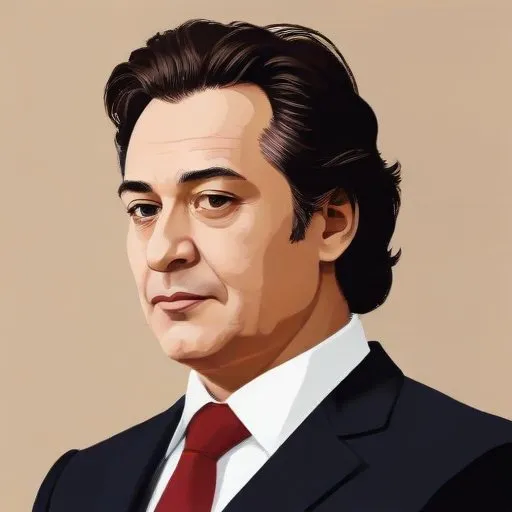
A Russian lawyer and politician who played a key role in the country's early 20th-century revolution, serving as the President of the Russian Provisional Council and advocating for democratic reforms.
Sergey Andreyevich Muromtsev, a Russian lawyer and politician, is best known for his instrumental role as the chairman of the First Imperial Duma in 1906, where he championed constitutionalism and democracy in Russia. His efforts to maintain order and dignity in the assembly, while pursuing a constitutional and anti-autocratic agenda, earned him praise and respect from his contemporaries.
Born on October 5, 1850, in Tula, Russia, Muromtsev came from a noble family and went on to study law at Moscow University. He earned a professorship in Roman Law, which he taught at Moscow University, and later built the Muromtsev Dacha in Moscow with his wife Marya in 1893.
In the late 19th century, Muromtsev was among the founders of the Constitutional Democratic Party, also known as the KD or Cadet party. He later became the party's chairman, solidifying his position as a prominent figure in Russian politics.
In April 1906, Muromtsev was elected as a representative for Moscow in the First Duma, and on May 10, he was elected chairman of the assembly. The Duma, often referred to as the "Duma of the Public Anger," was marked by turmoil and conflict, but Muromtsev's leadership helped maintain a sense of order and dignity.
Despite his efforts, the Duma was dissolved on July 21, 1906, by Imperial ukase of Tsar Nicholas II. Muromtsev proposed that the elected Duma retreat to Finland, which led to his imprisonment for several months and prevented him from being reelected in later Dumas.
Muromtsev's funeral on October 7, 1910, became an occasion for one of the first public demonstrations of support for constitutional ideas since the dissolution of the Duma. His niece, Vera Muromtseva, was married to celebrated Russian author Ivan Bunin.
In the 1870s, Muromtsev introduced a novel sociological approach to the study of law, employing functional and historical comparative methods. He was a staunch opponent of formalism and positivism, co-editing a journal with Maksim Kovalevsky from 1879 to 1892.
Muromtsev's life was marked by several personal milestones, including his marriage to Marya and the construction of their dacha in Moscow.
Muromtsev's commitment to constitutionalism and democracy had a lasting impact on Russian politics, paving the way for future generations of reformers and politicians.
While there are no direct quotes from Muromtsev, his actions and legacy speak to his dedication to the principles of democracy and constitutionalism.
Muromtsev's life and career were deeply embedded in the tumultuous landscape of late 19th and early 20th century Russia. His efforts to bring about constitutional reform and democracy continue to inspire and educate people today.
61 Years Old
Russian lawyer and politician who served as President of Russia from 2008 to 2012, known for his efforts to modernize Russia's economy and politics. He also served as Prime Minister from 2012 to 2020.
74 Years Old
A Russian politician who has dominated the country's politics for over two decades, known for his authoritarian leadership style and controversial foreign policy decisions.
95 Years Old
The last leader of the Soviet Union, who introduced reforms that led to the end of the Cold War and the collapse of communism, earning a Nobel Peace Prize. He's known for his policies of glasnost and perestroika, which transformed the Soviet Union and the world.
95 Years Old
First President of Russia, leading the country's transition from communism to democracy, and known for his bold reforms and iconic leadership style.
88 Years Old
A Russian politician who served as Prime Minister from 1992 to 1998, known for his role in shaping post-Soviet Russia's economy and politics.
70 Years Old
Russian economist and politician who played a key role in shaping the country's post-Soviet economy, introducing radical reforms to transition from a planned to a market economy.
