


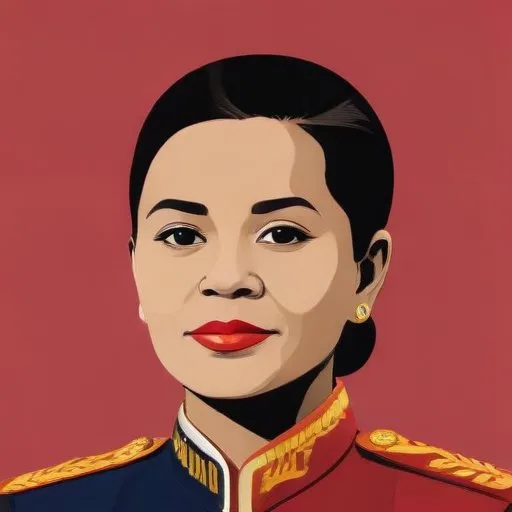
A Filipino revolutionary leader who played a key role in the country's struggle for independence against Spanish and American colonial rule, and later became a prominent politician.
Simen Ola y Arboleda, a name etched in the annals of Philippine history, is renowned for being the last general to surrender to the American forces after the Philippine-American War. This fearless commander led his troops with unwavering dedication, earning him a revered spot in the country's struggle for independence.
Born on September 2, 1865, in Albay, Philippines, Ola was the son of Vicente Ola and Apolonia Arboleda. He pursued philosophical studies at Mater Salutis College Seminary but never graduated. Instead, he joined the local branch of the Katipunan in his hometown province, eventually becoming its leader.
In 1901, Ola surrendered to the American forces, but only on the condition that his men would be granted amnesty. This decision was met with both understanding and criticism, as some viewed it as a necessary step to spare the lives of his troops, while others saw it as a capitulation to foreign occupation.
Following his surrender, Ola was put on trial and convicted of sedition. He was sentenced to thirty years in prison, a harsh punishment for his crimes against the occupying forces.
In 1904, Ola was granted a pardon and returned to his hometown, where he became the municipal president. This marked a new chapter in his life, as he shifted his focus from armed rebellion to public service.
Two controversies have surrounded Ola's legacy: his alleged earlier surrender as an officer major of Vito Belarmino in 1901, and the lack of documentation regarding his commission as general. Despite these challenges to his reputation, Ola remains an important figure in Philippine history.
Simen Ola passed away on February 14, 1952, and was initially interred at the Roman Catholic Cemetery of Guinobatan. In 2003, his remains were transferred to the Ola Shrine, a testament to his enduring legacy. The regional police command in Legazpi City was also named after him, a further tribute to his contributions to the Philippine Revolution.
Simen Ola's life serves as a powerful reminder of the complex interplay between sacrifice, loyalty, and the struggle for independence. His unwavering dedication to the Philippine Revolution and his people has inspired generations, cementing his place as a hero of the Philippine Revolution.
Born in 1869
Led the Philippine Revolution against Spanish colonial rule and later established the First Philippine Republic, becoming its first president. He's revered as a national hero for his fight for independence.
Born in 1878
The 2nd President of the Philippines, a key figure in the country's fight for independence from the US, known for his leadership during World War II and establishing a government-in-exile.
Born in 1878
The 4th President of the Philippines, a lawyer and politician who played a key role in the country's transition from American colonial rule to independence. He's most known for his efforts in rebuilding the war-torn nation after World War II.
Born in 1924
A former Philippine Defense Minister and Senator who played a key role in the country's martial law era and the People Power Revolution that toppled Ferdinand Marcos' regime. He's also known for his controversial legacy and disputed claims of being a hero or a villain.
98 Years Old
The 12th President of the Philippines, a decorated war hero and leader who implemented economic reforms and brought stability to the country after a tumultuous era. He's known for his efforts to modernize the Philippines and promote national unity.
93 Years Old
First female president of the Philippines, led the People Power Revolution, and restored democracy after decades of authoritarian rule.
93 Years Old
A Filipino journalist and politician who led the opposition against Ferdinand Marcos' regime, known for his courageous fight for democracy and human rights. Assassinated in 1983, his death sparked the People Power Revolution.
Born in 1917
A Filipino leader who ruled with an iron fist, implementing martial law and amassing wealth, leaving a legacy of controversy and economic turmoil.
