


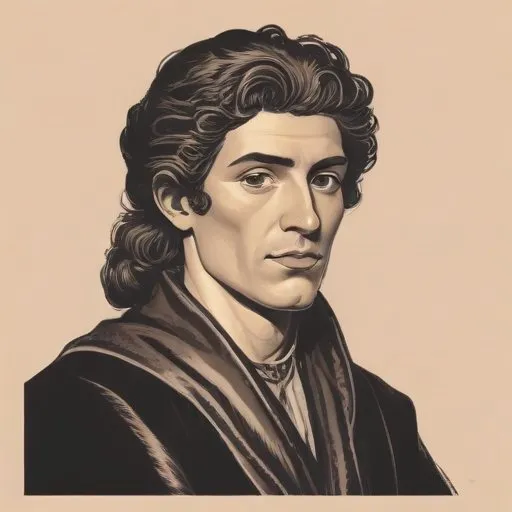
A Pre-Raphaelite painter of dreamlike, symbolic, and often homoerotic works, exploring themes of love, beauty, and mythology. Their art is characterized by vivid colors, intricate details, and a sense of mysticism.
Simeon Solomon was a British painter associated with the Pre-Raphaelite movement, renowned for his captivating depictions of Jewish life and his bold exploration of same-sex desire in his art. Born on October 9, 1840, Solomon's career was marked by both brilliance and controversy, leaving an indelible mark on the art world.
Solomon was born into a prominent Jewish family in London, the youngest of eight children to merchant Michael Meyer Solomon and artist Catherine Kate Levy. His siblings, Abraham and Rebecca, were also painters, and it was Abraham who introduced Simeon to the world of art around 1850. Solomon went on to attend Carey's Art Academy in 1852, where he honed his skills alongside his sister, who exhibited her work at the Royal Academy that same year.
In 1857, Solomon was introduced to Dante Gabriel Rossetti, a leading figure of the Pre-Raphaelite movement, which championed beauty, truth, and a return to medieval art. This encounter opened doors to the circle, where he befriended Algernon Charles Swinburne, the poet, and Edward Burne-Jones, the painter. Solomon's association with Swinburne led to his illustration of Swinburne's novel Lesbia Brandon in 1865, showcasing his talent for capturing literary themes.
Solomon's art often depicted scenes from the Hebrew Bible and genre paintings that showcased Jewish life and rituals, reflecting his heritage. His work also explored themes of same-sex desire, a bold move in a time when such expressions were socially unacceptable. His paintings, characterized by vivid colors and intricate details, demonstrated a deep understanding of human emotion and experience.
In 1873, Solomon's life took a dramatic turn when he was arrested for soliciting in public toilets and charged with indecent exposure and attempted buggery. Alongside his co-defendant, George Roberts, a 60-year-old stableman, Solomon was found guilty, fined, and sentenced to 18 months of hard labor. A second arrest in Paris in 1874 led to a three-month prison sentence. These events effectively ended his public career as an artist.
Despite the controversy surrounding his personal life, Solomon's art continues to captivate audiences today. His work has been recognized for its historical significance, offering a rare glimpse into the lives of Jewish communities in Victorian England. Solomon's courage in exploring same-sex desire through his art paved the way for future generations of LGBTQ+ artists. His legacy serves as a testament to the power of art to transcend time and societal norms.
Solomon's contributions to the art world have been acknowledged through various exhibitions and retrospectives. In 2005, the Birmingham Museum and Art Gallery hosted a major exhibition of his work, highlighting his importance as a Pre-Raphaelite painter.
Solomon's close friendship with Swinburne and his association with the Pre-Raphaelite circle reveal a complex and intriguing personality. His relationships with his family members, particularly his sister Rebecca, also played a significant role in shaping his artistic trajectory.
Simeon Solomon's remarkable life and art serve as a powerful reminder of the importance of embracing individuality and celebrating diversity in all its forms.
Born in 1828
A Victorian-era poet and painter who founded the Pre-Raphaelite Brotherhood, creating dreamlike, sensual works that explored themes of love, beauty, and mortality.
Born in 1830
A renowned Victorian-era poet and author, celebrated for her lyrical and symbolic poetry, particularly "The Goblin Market and Other Poems" and "The Prince's Progress".
Born in 1827
A British soldier-turned-artist, he co-founded the Pre-Raphaelite Brotherhood, creating vivid, symbolic, and emotionally charged paintings that explored themes of faith, morality, and beauty.
Born in 1829
A renowned Pre-Raphaelite artist, famous for his exquisite and intricate paintings, particularly "Ophelia" and "Christ in the House of His Parents", which showcased his mastery of color and detail.
Born in 1833
A leading figure in the Pre-Raphaelite movement, creating dreamlike, romantic, and mythological paintings that captivated the Victorian era. His works continue to inspire artists, designers, and writers to this day.
Born in 1834
A renowned artist and writer who revolutionized the Arts and Crafts movement with his stunning textiles, poetry, and novels, leaving a lasting impact on Victorian-era aesthetics.
Born in 1819
A prominent art critic and social reformer who championed the Pre-Raphaelite movement and advocated for social justice, leaving a lasting impact on art, architecture, and literature.
Born in 1821
A French-English soldier and painter who created vivid, detailed, and emotive works that captured the essence of Victorian-era England, particularly with his masterpiece "The Last of England".
