


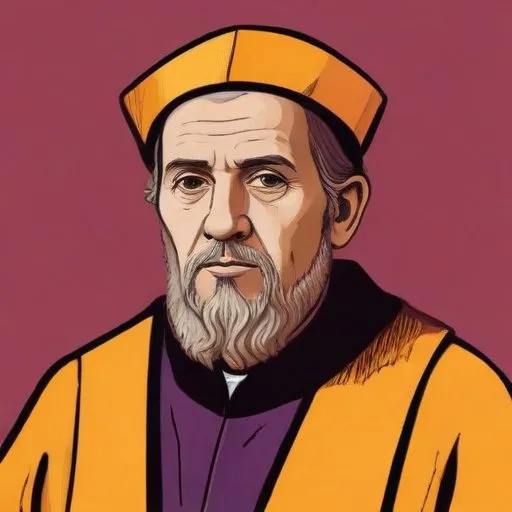
A Dutch theologian and academic who played a key role in the Remonstrant movement, advocating for Arminian theology and influencing the development of Protestantism. He's also known for his debates with Calvinist theologians.
Simon Episcopius, a Dutch theologian and Remonstrant, is renowned for his unwavering dedication to the Arminian cause, which culminated in his pivotal role at the Synod of Dort in 1618. His unrelenting passion and erudite writings continue to shape theological discourse to this day, making him an iconic figure in Christian theology.
Born on January 8, 1583, in Amsterdam, Episcopius pursued his academic aspirations at the University of Leiden, where he studied theology under the tutelage of Jacobus Arminius and Franciscus Gomarus. He graduated with a Master of Arts degree in 1606, setting the stage for his future ministerial and academic endeavors.
In 1610, Episcopius became the pastor of Bleyswick, a village near Rotterdam, where he passionately advocated for the Remonstrants' cause. His tireless efforts led to his appointment as a professor of theology at Leiden in 1612, succeeding Franciscus Gomarus. This significant milestone sparked intense controversy, as Calvinists vehemently opposed his appointment.
In 1618, Episcopius played a crucial role as the spokesman for the thirteen Remonstrant representatives at the Synod of Dort. However, his plea fell on deaf ears, and he was refused a hearing. The synod's adverse decision led to his expulsion from the country, forcing him to retire to Antwerp and eventually France.
During his exile, Episcopius dedicated himself to writing extensively in support of the Arminian cause. His magnum opus, the Remonstrant Confession, published in 1621, remains a testament to his unwavering commitment. His literary endeavors, however, did not go unchallenged, as he engaged in a theological controversy with Luke Wadding, who sought to convert him to Catholicism.
Following the death of Maurice, Prince of Orange, in 1625, the intensity of the Arminian controversy began to subside. In 1626, Episcopius was permitted to return to his homeland, where he resumed his ministerial duties. In 1630, he became the preacher at the Remonstrant church in Rotterdam, a position he held until his demise on April 4, 1643.
Simon Episcopius's fearless advocacy of Arminianism has left an indelible mark on Christian theology. His unyielding passion, coupled with his erudite writings, has inspired generations of theologians and scholars. As a testament to his enduring legacy, Episcopius remains an iconic figure, whose contributions continue to shape the theological landscape.
Episcopius's remarkable life serves as a beacon of inspiration, reminding us that even in the face of adversity, unwavering dedication to one's convictions can lead to a lasting impact on the world.
Born in 1560
A Dutch theologian who challenged Calvinist teachings, advocating for free will and conditional election, and is considered the father of Arminianism. His views shaped Protestant theology and sparked intense debates.
Born in 1583
A 17th-century philosopher and jurist who laid the foundations for modern international law, particularly the concept of "just war" and the laws of the sea.
Born in 1466
A 16th-century Renaissance humanist who advocated for education, tolerance, and critical thinking, and is famous for his witty and insightful writings, particularly "In Praise of Folly".
Born in 1509
A French pastor and theologian who played a key role in the Protestant Reformation, shaping Christian theology and influencing Western civilization. He's famous for his teachings on predestination and his role in establishing Calvinism.
Born in 1483
A German monk and priest who sparked the Protestant Reformation, challenging Catholic Church authority and shaping Western Christianity. He's famous for nailing 95 theses to a church door, sparking a religious revolution.
Born in 1497
A 16th-century Renaissance scholar who made significant contributions to the development of the Protestant Reformation and education, known for his theological writings and astronomical observations.
Born in 1924
Prolific author of macabre and suspenseful novels, often blending elements of horror, mystery, and dark humor, with works adapted into successful films and TV shows.
