


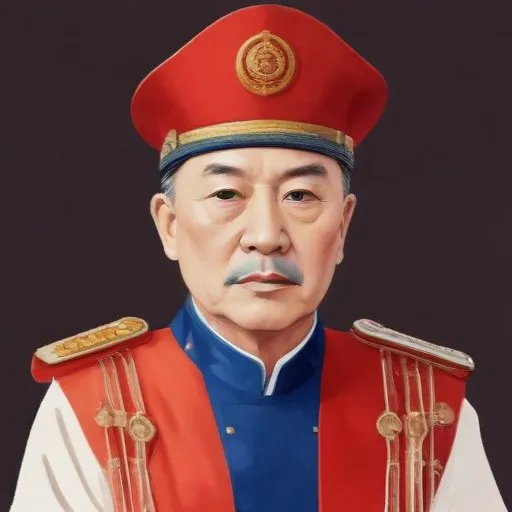
A renowned military strategist and statesman of the Northern Wei dynasty, known for his brilliant campaigns and reforms that shaped China's history.
Su Yu was a renowned Chinese military commander who played a pivotal role in the People's Liberation Army (PLA) during the Chinese Civil War and the Second Sino-Japanese War. He is esteemed for his exceptional leadership skills, strategic thinking, and bravery, earning him the recognition of being one of the best commanders of the PLA, alongside Peng Dehuai, Lin Biao, and Liu Bocheng.
Su Yu was born on August 10, 1907, in Huitong County, Hunan Province, to an ethnic Dong family. He was the third child among six siblings. His family relied on their 30 mu of inherited farmland for survival. Su Yu pursued his post-secondary education at the Hunan Provincial 2nd Normal School in Changde, entering the institution at the age of 18.
In 1926, Su Yu joined the Communist Youth League of China, and in 1927, he became a member of the Chinese Communist Party. He participated in the Northern Expedition and later the Nanchang Uprising. During the 1930s, Su Yu emerged as one of the most skilled guerrilla commanders in the Jiangxi Soviet. Although he did not join the Long March, he was tasked with fighting against Nationalist troops, conducting a delaying action in the south of Zhejiang until 1937.
When the Second Sino-Japanese War broke out in 1937, Su Yu was appointed Deputy Commander of the 2nd Detachment and later became the commander of the Advanced Detachment of the New Fourth Army. His military prowess was evident in several key battles, including the Battle of Menglianggu, the Battle of Huaihai, the Yangtze River crossing, and the capture of Shanghai. During the Chinese Civil War, he commanded the East China Field Army, later renamed the Third Field Army in 1949.
After the Chinese Communist Party's victory in the civil war, Su Yu held various important positions in the new People's Republic of China, including PLA Chief of General Staff from 1954 to 1958. His illustrious military career and strategic contributions have left an indelible mark on modern Chinese history.
Su Yu's life was marked by several significant events, including his participation in the Northern Expedition, the Nanchang Uprising, and the Long March. His experiences during these events shaped his military prowess and strategic thinking, ultimately contributing to his rise as one of the most respected military commanders in Chinese history.
Su Yu's military career is often compared to that of his contemporaries, including Peng Dehuai, Lin Biao, and Liu Bocheng. While each of these commanders had their unique strengths and weaknesses, Su Yu's exceptional leadership skills, strategic thinking, and bravery set him apart as one of the most accomplished military commanders of his time.
Su Yu's legacy continues to inspire generations of Chinese military leaders, solidifying his place as one of the most revered and accomplished military commanders in modern Chinese history.
Born in 1893
Leader of the Chinese Communist Party who implemented radical social and economic reforms, including the Great Leap Forward and the Cultural Revolution, shaping modern China's politics and economy.
Born in 1898
The first Premier of the People's Republic of China, serving from 1949 until his death in 1976, is most known for his key role in the Chinese Communist Party and his diplomatic efforts to improve relations with the West. He played a crucial part in shaping China's foreign policy and economy during a pivotal period in the country's history.
Born in 1898
A prominent military leader who played a crucial role in the Chinese Civil War and later became a key figure in the Communist Party, known for his criticisms of Mao's policies. He was eventually purged and persecuted during the Cultural Revolution.
Born in 1907
A powerful Chinese military leader and politician who rose to prominence during the Chinese Civil War and later became a close ally of Mao Zedong, playing a crucial role in the Cultural Revolution. He is infamous for his alleged plot to overthrow Mao and his mysterious death in a plane crash.
Born in 1904
A Chinese revolutionary and statesman who led the country's economic reforms, transforming it into a global superpower. He's credited with opening up China to the world and introducing capitalist principles.
73 Years Old
A renowned Chinese violinist and composer, blending Eastern and Western musical styles, creating a unique sound that showcases cultural fusion.
Born in 1896
A prominent Chinese military leader and politician who played a key role in the Chinese Civil War and later served as the 1st Vice Premier of the People's Republic of China, known for his efforts in modernizing the Chinese military. He was a close ally of Mao Zedong and helped establish the People's Liberation Army.
